| OCR Text |
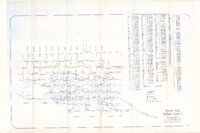
Show FALL 2013 UHQ pp 304-385_UHQ Stories/pp.4-68 9/16/13 1:25 PM Page 379 MUrDEr AND MAPPING a day, eventually reached Elk Ridge. Morton’s group re-crossed Elk Ridge and took what was then called the Settlement Road into Bluff. There, with their mounts fed and rested, the party mingled among Indians and settlers collecting information.20 For Morton, reaching the Colorado River via Elk Mountain had been a major objective; because he did not obtain this goal, the area required further exploration and mapping. However, this trip did yield some important points for future travelers. Chief among these was the crucial knowledge of the location of “tanks,” hollow pockets in sandstone that trap valuable rainwater from summer storms. Unless a person was intimately familiar with the land, there was no predicting the tanks’ locations; only a sure knowledge would do. The complexity of the canyons and box canyons that run in all directions mired many travelers in a morass of rock that seemed impenetrable. Morton emphasized that the terrain—with its sand, canyon mazes, dead ends with drop-offs, and limited springs—severely hampered normal travel time.21 From July to October, more reconnaissance followed, so that by the end of the summer a final report could give a far more complete description.22 Morton and two other lieutenants—R. R. Stevens and William P. Burnham, who were assigned to help with mapping—conducted much of this exploration. Along with six privates, these three officers investigated the areas between the San Juan River and Colorado River confluence and between the White Canyon and the Recapture Creek drainages, as well as north and east of Blue Mountain.23 Morton, synthesizing the information he and the others found, correctly summarized what numerous fights had proven: The country between Elk Ridge and the Colorado is a natural Indian stronghold, and in my opinion, is the place to which the Indians would go in case of hostilities. . . . If the Indians were hard pressed in the country I have mentioned, they could go into Arizona, slip back to their reservation or cross the Colorado. The country on the west side of the river is said to be quite as rough as that on the east.24 However, unlike Osborne and Stevens in their 1885 report, Lieutenant Morton felt there was no necessity for a post, only a spring-to-fall encampment, since substantial conflict seemed only to occur during that time of year. He believed that it was the Mormons, not the cowboys, who wanted a post, to which they could sell their products. The cowboys, on the other hand, thought a post would ruin their ranges as it attracted more settlers and would also expose their illicit activities. 20 Morton to Assistant Adjutant General, Department of the Platte, July 15, 1886, Letters Received— AGO; Robert S. McPherson and Winston B. Hurst, “The Fight at Soldier Crossing, 1884: Military Considerations in Canyon Country,” Utah Historical Quarterly 70, no. 3 (Summer 2002): 258–81 21 Ibid. 22 C. G. Morton to Assistant Adjutant General, May 2, 1887, Letters Received—AGO. 23 “Record of Events,” Fort Douglas Post Returns, July 3–August 28, 1886, Fort Douglas, Salt Lake City, Utah. 24 Morton, “Report: Southeastern Utah,” April 30, 1887, Letters Received—AGO. 379 |