| OCR Text |
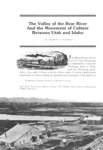
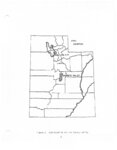
Show 212 Utah Historical Quarterly Valley, for example, was slow in developing homestead districts or string settlements. Indeed, Lowry Nelson found no families living on scattered farms at Ephraim as late as 1950. The same held true for Escalante in Garfield County.'13 The physical character of the Bear River also contributed to changing methods of land and water utilization in Utah's Box Elder County. Small streams had been developed to found Brigham City and Malad, but the Bear River itself had been beyond the ability and capital of early settlers to develop. In the years after 1887 private capital and land speculators undertook to dam the river where it leaves Cache Valley and to construct vast canal systems on both sides of the river. The new district was promoted in the Midwest and Europe as having great promise for orchard husbandry." A variety of problems beset the promoters until 1902 when Utah and Idaho Sugar Company acquired all assets, introduced sugar beets, and successfully distributed land to a great number of farmers. Although Garland, Bear River City, Tremonton, and Bothwell were among the new tow7ns that developed, many people settled on farms and in string settlements extending along the Wellsville Mountains and elsewhere. A group of Iowa immigrants located along one strip in the middle of the valley, resulting in a Garland road that is still called the Iowa String. Although too much can be made of this Bear River land and water project, as an extension of cultural patterns from one state to another, it was among the foremost of a great many speculative projects in the 1890s and early years of this century and was more akin to Idaho's Snake River w7ater developments of this century than to earlier Mormon irrigation projects. Dry-farming, too, was very much a development of the Bear River valleys. As in much of Idaho to the north, rainfall here w7as a little more abundant than in Utah generally. Without the cultural affinity that was attached to irrigation in Mormon Utah, dry-farming was quickly accepted in Idaho's Bear River country. When John A. Widtsoe became a great advocate of scientific dry-farming at Utah State Agricultural College, his efforts to promulgate the new science extended north as well as south. Trains especially equipped to teach the rudiments of the new science toured the Bear River counties in Idaho as w7ell as Utah. In a real w7ay, however, Widtsoe's efforts carried a transitional mode of farming from '" G. Lowry Nelson, The Mormon Village: A Pattern and Technique of Land Settlement (Salt Lake City: University of Utah Press, 1952), pp. 139-40, 164,87. 44 The best treatment of this development is Charles Hillman Brough, Irrigation in Utah. . . (Baltimore: Johns Hopkins Press, 1898). |