| OCR Text |
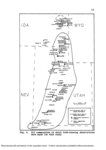
Show Forces That Shaped Utah's Dixie 115 Cardenas—reached to within a hundred miles of Utah's Dixie in their quest for gold, glory, and God. 10 How7ever, it was settlements in Alta, California, in the second half of the eighteenth century that brought Spaniards to Dixie. 17 During the summer of 1776 Padre Garces, a kind of Catholic Jacob Hamblin, explored a northern Arizona route between central California and the Hopi villages. His report mentions the "Pauches" living north of the Colorado, that is, in Utah's Dixie. 18 T h a t summer also two Catholic priests—Fathers Atanasio Dominguez and Silvestre Velez de Escalante— led a small expedition north from Santa Fe, through southwestern Colorado into Utah's Uinta Basin, west to Utah Lake, and then south. Their destination had been Monterey, California, but a heavy snowstorm below present-day Delta, Utah, forced a change of plans. T h e new objective was to return to Santa Fe as quickly as possible across the Colorado River. 19 T h a t decision put Utah's Dixie on the m a p literally. Don Bernardo Miera y Pacheco identified the Virgin River, Ash Creek, Pearce's Wash, and the Hurricane Fault—not by those names, how ever. Fathers Dominguez and Escalante also gave a good description of the mild climate of mid-October and of the Indians and their small farms. Devout Dixieites may wonder why the padres did not just stop and stay, especially with name potentials like St. George and Santa Clara for the area. However, the party's condition was quite desperate, and the padres needed to make their report. O n their return to Santa Fe they discovered the old Indian crossing of the Colorado River, since known as the Crossing of the Fathers. 20 T h e next fifty years became a period of transition. Mexico won her independence from Spain in 1821 and claimed control of the area. Even so, Americans with and without their Mexican cohorts trapped west of Santa Fe for fortunes in furs. Three such expeditions had particular impact on Utah's Dixie. Coming from northern Utah, Jedediah Smith's group reached the Adams or Virgin River (over the Black Ridge) in the late summer of 1826. H e noted the Indian fields at Corn Creek ,,! Smith, "Colorado River," chap. 4, provides a detailed review of the Spanish activities. See Herbert E. Bolton, Spanish Exploration in the Southwest, 1542-1706 (New York: Barnes and Noble, 1907), for this story. ]S Elliot Coues, ed., On the Trail of a Spanish Pioneer: The Diary and Itinerary of Francisco Garces (Missionary Priest) . . . 1775-1776 (New York, 1900), 2 : 3 5 0 - 9 7 . VJ Warner, Dominguez-Escalante Journal, pp. 7 3 - 7 5 . ' ' I b i d . , pp. 9 9 - 1 0 1 . See also David E. Miller, "Discovery of Glen Canyon, 1 7 7 6 " Utah Historical Quarterly 26 (1958) : 221-37. 17 |