| OCR Text |
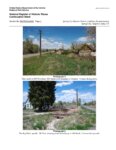
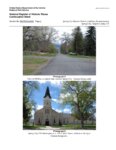
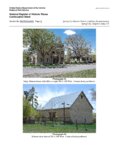
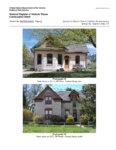
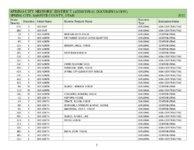
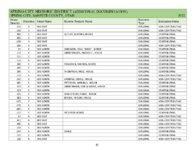
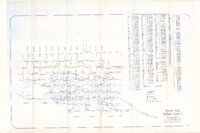
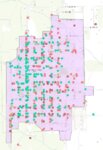
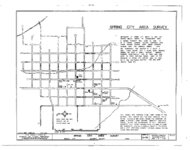
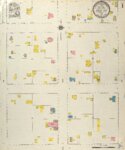
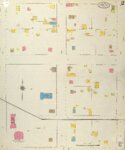
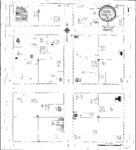
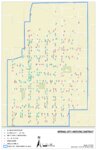
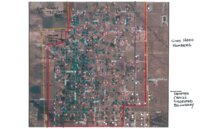
Show United States Department of the Interior National Park Service OMB No. 1024-0018, NPS Form National Register of Historic Places Continuation Sheet Section No. 8 Page 7 Spring City Historic District (Addition Documentation), Spring City, Sanpete County, UT as the origin point. For example, First Street became 2nd West (or 200 West) and “A” Street was renamed 4th South (or 400 South). 54 Address numbers were not commonly used until the 1990s. 55 Historian, Tom Carter, in his study of Sanpete County development patterns stated, “In the early days the [settlements] were characterized by small clusters of houses standing at each intersection separated by large open spaces on the block interiors.” 56 This community planning pattern can be seen in Spring City throughout the period of significance. Carter describes the general feeling in this way: “Houses were invariably placed on the corner closest to the street intersections, yielding a crossroads effect. This was especially true before the lots began to be subdivided.” 57 In contrast to some of the larger cities in the Sanpete Valley, the majority of lots in Spring City were never subdivided, a pattern that continues to the present. The only exception to the pattern is along Main Street, where most of the frontage lots have been subdivided at least once, or more in the historic business district between 200 South and 200 North. The “crossroad effect” can be seen on the 1917 Sanborn fire insurance map, a 1934 map of Spring City’s waterworks, USDA aerials photographs (beginning in 1939 to 1964), and high-resolution satellite photographs available today. The population of Spring City has continued to grow since 1980, from a population of 671 to 949 on the 2020 census. There are no subdivisions in Spring City, past or present. Even the southwest quadrant where has most of the growth has occurred since 1980, almost all the newer homes are on a corner of an undivided 1.25-acre parcel. These patterns of development have been perpetuated even through a series of civic improvements. A new cemetery outside of the town limits superseded the Pioneer Cemetery in 1869. In 1881, the telegraph lines reached Spring City. The city’s first telegraph operator was John L. Allred, who was listed on the 1870 census as a telegraph operator at only thirteen-years old. The first telephone was installed on November 20, 1900. The Spring City Light & Electric brought electricity to Spring City in 1901. The first sidewalks were installed in 1913. A modern system of piped culinary water was completed in 1935. Main Street improved and designated part of US Highway 89. The realignment of US 89 one mile west in 1957 was the event that preserved Spring City for the historians who began coming to document the town in the late 1960s and early 1970s. Criterion C: Architectural Significance of the Spring City Historic District The Spring City Historic District (Additional Documentation) is significant under Criterion C is the area of Architecture for a number of individual properties that embody the distinctive characteristics of three periods: the traditional/vernacular period, the pattern book period, and the twentieth-century American architecture period. The original 1980 nomination uses the term “folk design” to describe the traditional and vernacular buildings built from the settlement period and to the 1880s. The 1980 nomination defines the pattern book period as the 1880s to the early 1900s. Overall the examples from these periods have good historic integrity in the qualities of design, materials and workmanship. Several represent the work of master stone masons. Two are the based on the designs of noted Utah architect Richard C. Watkins. This amended nomination extends the period of significance to also include a number of excellent examples in Spring City that represent the twentieth-century Americanization of architecture in rural Utah. Spring City is also architecturally significant for its collection of buildings that lack individual distinction but contribute to the historic character of the 54 The 1934 city waterworks map includes all three street names with the current designations added later in a different hand. The map also includes a notation for “Spit’n Whittle Ave” along 100 North between Main and 100 East. 55 A 1990 update of the district map includes a table to convert the site numbers to addresses. The 1999 survey map uses only the address numbers. 56 Building Zion, p. 83-85. 57 Ibid, p. 83. |