| OCR Text |
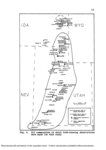
Show 124 Utah Historical Quarterly alphabet, a distinctive cooperative economic system, polygamy, political theocracy, and, hopefully, political autonomy and economic independence. 47 Church leaders, members of the Council of Fifty, and the Saints generally, set about their tasks with a will. However, they were continually kept off balance by national events. By July 1847 when the first Mormons arrived in Utah, the Mexicans had been defeated, and by February 1848 the region was officially United States territory. Obviously there would be no separate, independent Mormon nation. Next best would be the near autonomy of statehood. In March 1849 the Mormons petitioned for entry into the Union as the state of Deseret and set about to explore the vast region they had defined.18 Again the nation said no. It was U t a h Territory with a lot less land. T h e area to the southwest had its attraction for church leaders, especially as an all-weather route to the Pacific over which immigrants and freight might come to Zion. l9 Parley P. Pratt had reported on Dixie's mild climate in 1849-50. By 1850 Parowan had been settled, and the following year a group of Mormons founded an outpost of Zion at San Bernardino. Almost immediately, the Southern Indian Mission brought the Mormons into Dixie: John D. Lee to upper Ash Creek in 1852, Jacob Hamblin to Santa Clara in 1854, and Rufus Allen and William Bringhurst to Las Vegas in 1855. T h e missionaries discovered, incidentally, that cotton would grow. Wives came to Santa Clara and settlers to Washington in 1856 and 1857. An experimental cotton farm operated one year later at Heberville, above present Bloomington. Settlements sprang u p along the river during the next three years as the Indian Mission gave way to the Cotton Mission. " W h a t did all this mean to Mormon leaders? First of all, Dixie provided an opportunity to convert the Indians, the Lamanites. Secondly, it reinforced their hoped-for safe route from California to Salt Lake City. It also promised economic independence in such items as grapes for wine, tobacco (for Gentiles, presumably), and for cotton. Their plans for economic security extended even further—to the Sandwich Islands of the South Pacific for sugar plantations.' 1 47 Arrington, Great Basin Kingdom. D a l e L. Morgan, " T h e State of Deseret," Utah Historical Quarterly 8 (1940) : 67-239. 4 " Letter of Brigham Young, December 5, 1864, in Millennial Star 27 (1865) : 4 1 . 5,1 A. Karl Larson, / Was Called To Dixie: The Virgin River Basin, Unique Experiences in Mormon Pioneering (Salt Lake City: Deseret News Press, 1961). 51 Leonard J. Arrington, "Inland to Zion: Mormon Trade on the Colorado River, 18641867'," Arizona and the West 8 (1966) : 239-50. ,s |