| OCR Text |
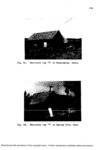
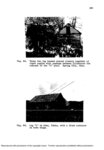
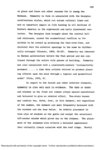
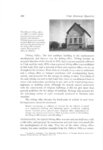
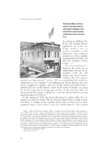
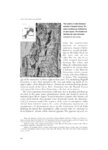
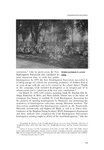
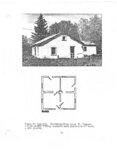
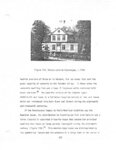
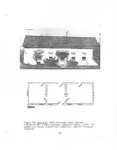
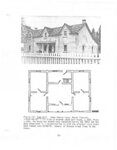
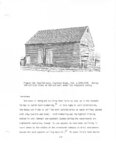
Show LDS Church Architecture 303 of individual buildings, or, in some cases, a fort or stockade. Each day's work was planned in meetings, and every person had specific jobs to do, usually related to his particular skills and equipment. One of the first tasks was the planning of a large block in the center of the village for public buildings. T h e first building would be a multi-purpose meetinghouse. 4 In Utah, religious architecture begins with the construction of crude, temporary log meetinghouses. 1847-52 The First Meetinghouse. Virtually all. of the old Mormon settlements, and many of those in the early twentieth century as well, built at least one prearchitectural meetinghouse. Since by definition architecture deals with principles of artistic expression as well as pure structure, early log meetinghouses do not strictly qualify as architecture. These very small early buildings were all structure and no styling. T h e first meetinghouse built in Farmington in 1849 measured only sixteen-by-eighteen feet. This log structure had a roof of willows and dirt and a floor of puncheon or split logs, smoothed with an adz. Seats were also made of split logs with holes bored in each end and stakes put in the holes for legs. The walls were chinked from the outside and plastered with mud. When a new meetinghouse was built in Farmington in 185253, the old one was moved and used for a blacksmith shop. 5 The typical first meetinghouse was a detached structure, but some were included as part of a fort. Most were e:rected quickly, sometimes in less than a day. These crude log buildings must have seemed dismal to the Mormons who remembered the proud masonry structures they had left in Nauvoo. A description of the first Brigham City meetinghouse, built in 1853, capsulizes an attitude many may have shared: EARLY S E T T L E M E N T , OR PREARCHITECTURE, Even the log meetinghouse, with its ground floor and earth roof, was more extensively patronized as a receptacle for bed bugs than for the assembly of saints.6 The Bowery. Another early religious building was an arborlike structure called a bowery. T h e idea seems to have been a refinement of the open-air meetinghouses of Nauvoo. 7 Boweries may not have been con3 W.H. Dixon, New America (Philadelphia, 1867), 177. Leonard J. Arrington, Great Basin Kingdom: An Economic History of the Latter-day Saints, 1830-1900 (Cambridge, Mass., 1958), 90. 5 Andrew Jenson, ed., "Farmington Ward History," Archives Division, Historical Department, Church of Jesus Christ of Latter-day Saints, Salt Lake City. 6 Andrew Jenson, ed., "Brigham City Ward History," LDS Archives. 7 David E. Miller and Delia S. Miller, Nauvoo: The City of Joseph (Salt Lake City, 1974), 69-70. 4 |