| OCR Text |
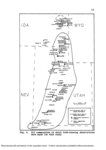
Show Forces That Shaped Utah's Dixie 119 Spanish culture and economies—adobe building and irrigation of arid lands—and to the potential of the country itself." By 1848 the nation's claims had been staked. Dixie w7as American territory. However, it was the discovery of gold in California that fully unleashed the forces of nation building. First came the westward rush of gold seekers, some of whom passed by on portions of the Old Spanish Trail in lower Dixie. Next came the political organization of the conquered area as the state of California and as the territories of New Mexico and Utah. Three years later transcontinental railroad surveys passed by to the south and to the north of the area,32 as did the pony express and telegraph lines (north) a few years later. During these years federal policy generally viewed the Indians as antagonists and sought to keep them as quiescent as possible. However, both Indian and Mormon unrest on occasion brought the United States Army into the area. With troops there, the federal government looked for new and better supply lines and saw the Colorado River with an overland route through Dixie as one possibility. Lt. Joseph C. Ives's survey of the lower river at the time of the Mormon War (1857-58) had that as one of its objectives. He also produced an excellent report on the condition of the lower river.1! The decade of the 1860s brought many new conditions to the region. Mining amputated the western part of Utah's domain as the territory of Nevada in 1861, and brought Nevada statehood in 1864. More mining, along the Colorado River and later at Pioche and Panaca, Nevada, brought steamers above the great bend of the Colorado River (1866). 34 For similar reasons Arizona Territory was carved out of western New Mexico in 1863. These manipulations brought a changing and confusing political climate to Utah's Dixie.33 It was gold that was speaking, and it was gold that Mormon settlers lacked most of all. ::1 "Journal of Robert S. Bliss with the Mormon Battalion," Utah Historical Quarterly 4 ( 1 9 3 1 ) : 8 3 ; and "Extracts from the Journal of Henry W. Bigler," Utah Historical Quarterly 5 (1932):53. 2 " LeRoy R. Hafen and Ann W. Hafen, eds., Central Route to the Pacific by Gwinn Harris H e a p (Glendale, Calif.: Arthur H. Clark Co., 1957), pp. 5 2 - 6 3 ; Lt. R. S. Williamson, Report of Exploration in California for Railroad Routes in Reports of Explorations and Surveys . . . 1853-54 (Washington, D.C., 1856), 5 : 7 - 8 ; and Grant Foreman, ed., A Pathfinder in the Southwest . . . ( N o r m a n : University of Oklahoma Press, 1941), pp. 147-279. ""Joseph C. Ives, Report upon the Colorado River of the West ( 1 8 6 1 ; reprint ed., New York: D a Capo Press, 1969), pp. 5-100. :|4 Richard E. Lingenfelter, Steamboats on the Colorado River, 1852-1916 (Tucson: U n i versity of Arizona Press, 1978), p p . 73-103. ""Donald Bufkin, " T h e Lost County of Pah-Ute," Journal of Arizona History 5 (1964) : 219-40. |