| OCR Text |
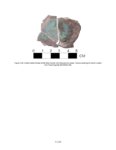
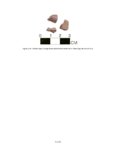
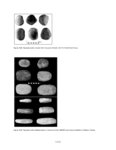
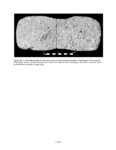
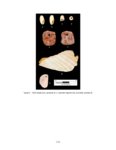
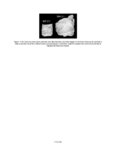
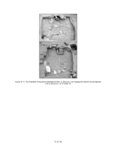
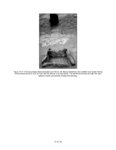
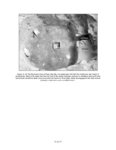
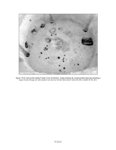
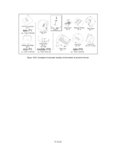
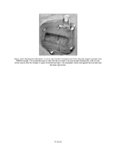
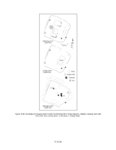
Show manos and metates (and also mauls). This material is well cemented and comes in a variety of grain sizes and textures with abundant natural vesicles. Beals et al. (1945:79) first reported on this material, learning of it from their Navajo workers when they identified the tool stone for several mauls from a site in the Kayenta Valley as deriving from "somewhere near Navajo Mountain." These workers specifically stated how the stone was prized for manos. As of 2000, a Navajo woman (Mrs. Holgate) living at the foot of this mountain still produced manos and metates of this stone, the last Navajo doing so on the western reservation. Evidence for prehistoric production of grinding tools in the Navajo Mountain area consists of the common recovery of mano and metate blanks at most sites (e.g., Lindsay et al. 1968:292-293; Geib et al. 1985:379, Table 98). In contrast, only a single mano blank was found at one of the excavated sites within the portion of the N16 ROW on the Shonto Plateau (Russell 1989a). Even more telling is the abundant flaking and pecking debris at some habitations at the foot of Navajo Mountain (UT-V-13-19, Geib et al. 1985:192, Figure 65). The NMRAP excavations found that grinding tool production debris increases from absent or very low as one moves northward from the Shonto Plateau and onto the Rainbow Plateau, not becoming significant until nearing the foot of Navajo Mountain. The rock fraction of flotation samples should be even more informative of this activity. The NMRAP Puebloan habitations near the base of the mountain also produced unused manos in various stages of completion, further evidence of local production that was not found at habitations farther south (see Chapter 6 of Volume V and the site descriptions of Volume IV). The production activity might have been all for local use, but there are several reasons to think not. First is the fact that manos, metates, and mauls of Navajo Mountain sandstone occur at sites well away from the source, sites that lack any production debris. The finds of Beals et al. (1945) are just one notable example. Exchange thus seems likely. Also, given the use-life of manos and metates, the amount of debris noted at sites such as UT-V-13-19 seems far in excess of the needs of one small household. The production scale was likely that represented by Mrs. Holgate-part-time on a catch-as-catch-can basis in between the other daily chores of life. This seems to be the scale of all craft activity in the Kayenta region and is likely a factor in why it is so difficult to detect and why Kayenta households are sometimes portrayed as autonomous. But as anthropologists have learned, all societies interact with their neighbors to varying degrees and through various culturally structured mechanisms, and material exchange is one of them. Grinding tools highly suitable for intensive maize processing represented a real need across much of the Kayenta region, a need that some families living around Navajo Mountain appear to have willingly met by producing more manos and metates than were required at home. I started this discussion of craft production and exchange by talking about stone tools rather than ceramics, which so frequently figure prominently in such discussions. This does not mean that the NMRAP recovered no evidence for ceramic production-quite the contrary, as Chapters 2 and 4 of Volume V demonstrate. Part of the effort on this project involved further exploration for clay resources in the Kayenta region as a means to help shed light on potential production areas (Geib and Callahan 1987), the results of which are summarized in Appendix H3 and H4. The trend noted by Fairley and Callahan (1985; also Callahan and Fairley 1983) for greatly increased localized production of utility ware on the Rainbow Plateau during Pueblo III has been confirmed by the NMRAP findings. Prior to Pueblo III, virtually all utility ware of the northern Kayenta region appears to have been imported from the core Kayenta area to the south such as the Klethla or Long House Valleys, since it is made from light-firing clays tempered with a non-local sandstone and is a perfect match for typical Tusayan Gray Ware. Puebloans on the Rainbow Plateau during Pueblo III increasingly experimented with local production using a wide variety of clays, tempers, and surface treatments. By at least AD 1200 inhabitants on the Rainbow Plateau had established a local utility ware tradition known as Rainbow Gray based on use of crushed sandstone temper and iron-rich clays (Callahan and Fairley 1983). Local production of utility ware on the Rainbow Plateau appears to have been only for local use rather than exchange, at least not outside of the northern Kayenta region since sites on the Shonto Plateau lack Rainbow Gray. None was found at the Pueblo III sites on the southern portion of the N16 ROW (Blinman 1989), including the middle Pueblo III habitation of Ditch House excavated by the NMRAP. Despite the localized production of utility ware during Pueblo III, some utilitarian vessels appear to have been imported to habitations of the northern Kayenta region from the south since typical examples of Moenkopi Corrugated and Kiet Siel Gray occur in Pueblo III assemblages on the Rainbow Plateau. Importation of Tusayan White Ware also continued, with much of it taking the form of the volcanic ash- tempered pottery Tusayan and Kayenta Black-on-white, the production of which appears to have become increasingly specialized in the Klethla Valley. The sourcing of volcanic ash in sherds from the project area and elsewhere indicates that two different ash sources were being used and that movement of vessels V.16.9 |