| OCR Text |
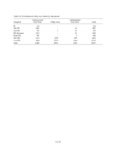
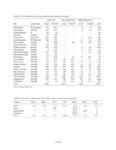
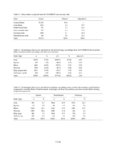
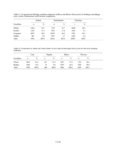
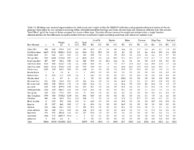
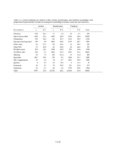
Show percent by weight given the small size of this debris relative to core flakes. Biface flakes come from the percussion thinning and shaping of bifacial tools and they can be detached during initial preparation of a tool or during its subsequent modification, especially by resharpening worn edges (Frison 1968). Any percussion bifacial reduction flakes in the NMRAP assemblage that could be identified as coming from the resharpening of a worn biface were classified as tool rejuvenation/spall. Separately identified in the analysis but included in the bifacial reduction category for most data comparisons are overshot flakes and edge removal flakes-both of which are common to percussion biface reduction (for good illustrations of both seee Phagan 1980: Figure 6-1). Pressure flakes are the third most common flake type, accounting for 16 percent of the overall assemblage by count. By weight this flake type represents less than 1 percent of the assemblage; this vast reduction in representation from count to weight is a direct result of how tiny this debris is in comparison to other flake types. Pressure flakes are normally very small,5 usually less than 1/4" in size and well below 1 g in weight. Of course, not all small flakes are from pressure flaking; percussion also results in much tiny debris. The identification of pressure flakes usually assumes the presence of an intact platform. The flakes commonly have bending initiations, shallow or no bulbs of force, often high flake scar counts relative to flake size, and somewhat complex scar patterning. Many of the pressure flakes represent miniature biface thinning flakes, having been detached from bifaces by pressure rather than percussion. Pressure flakes from unifacial tools such as scrapers can be differentiated from those removed from bifaces, but this was not attempted in this study. The one special subtype of pressure flake that we recognized was notching flake, following Titmus (1985) and Towner and Warburton (1990), although for most data comparisons they are lumped into the pressure flake category. Pressure flakes come from producing and resharpening flaked facial tools, particularly bifacial tools such as knives, projectile points, and drills, but also unifacial tools like scrapers. Edge preparation flakes are almost as well represented as pressure flakes. These are generally small flakes removed from cores in an effort to remove core overhangs or regularize margins. Included here are alternate flakes (Crabtree 1972:33), removed to eliminate a square edge from a nodule, flake, or broken tool for the purpose of preparing a margin for use or further reduction. Edge preparation flakes generally have simple platforms (single scars or cortex), Hertzian initiations (except for alternate pressure flaking), simple dorsal flake scar patterns, and low counts, often one or two scars oriented with the axis of percussion. Alternate flakes are like this except that they are markedly asymmetrical and usually wider than they are long, expanding as they do in one direction at an angle to the platform surface. In hindsight it would have been more informative to separate alternate flakes, which are usually associated with biface reduction, from edge preparation flakes associated with core reduction. A fifth debitage category, tool rejuvenation flakes or spalls, are those purposefully or accidentally detached from tools that retain use-wear from the original tool form or in a few cases that retain an identifiable part of the original tool such as a projectile point barb. Frison (1968) drew special attention to tool resharpening flakes, identifying five different types. Here we include all retouch flakes or tool spalls in a single category and use a separate attribute (rejuvenation type) to designate the inferred type of tool that the flake came from. In hindsight, it would have been more informative to classify the flakes according to one of the other flake types previously described, such as pressure flake or core flake, with the rejuvenation type variable serving to designate the inferred tool that the flake came from. Frison's rejuvenation flakes are all derived from flaked facial tools such as scrapers and bifaces. Many of the rejuvenation flakes of the NMRAP came from core/nodular tools, especially pecking stones. These exhibit extensive battering and crushing of the platform/dorsal juncture and often battering on a portion of the dorsal surface as well. The least represented flake type overall, but one that comprises a significant proportion of the debris at certain Puebloan sites, is bipolar. Definitions of bipolar flakes are almost as ubiquitous as for bifacial thinning flakes (Binford and Quimby 1972; Hayden 1980; Honea 1965; Shott 1989). A principal defining characteristic of bipolar debris relates to flake initiation and propagation by wedging and compression (Cotterell and Kamminga 1987). Bipolar flakes lack bulbs of force, have very flat ventral surfaces that can be markedly rippled, and are often fractured or crushed at the point of initiation (crushing on the distal end might be present but often is absent). Many bipolar flakes have triangular or blocky sections resulting from shearing cores or flakes into several pieces. This technique creates an abundance of angular shatter (see Flenniken 1981:43, Figure 24), but familiarity with the technique allows debitage to be identified as bipolar when those less familiar with the technique might consider them to be undiagnostic. 5 That this is not always the case is well demonstrated by Mesoamerican prismatic blades. V.5.10 |