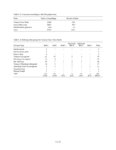
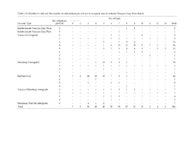
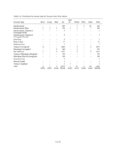
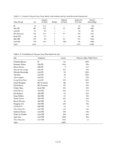
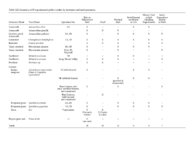
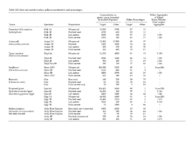
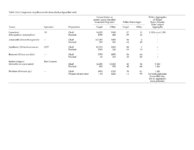
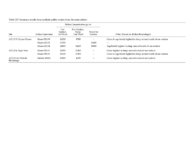
| OCR Text |
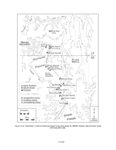
Show BASKETMAKER SETTLEMENT Early excavators implicitly recognized that Basketmaker II groups used different places on the landscape for certain purposes. Kidder and Guernsey (1919:206-207), for example, referred to some Basketmaker rockshelters as burial caves, some as a combination of both food storage and burial, and some as "dwelling places." Although believing that rockshelters were inhabited, they thought such use was for rather short periods and perhaps just during winter. In a speculative but perspicacious mode they stated, "it seems probable, therefore, that the people lived during a large part of the year in the open, where they presumably erected temporary houses analogous to the summer shelters of the Navajo" (Kidder and Guernsey 1919:207). Essentially this was as far as discussion went concerning Basketmaker II land use until the 1960s. By then, the discipline of archaeology had matured somewhat and settlement studies had become almost de rigueur. Initially inspired by Julian Steward (1937a, b) and furthered by Gordon Willey (1953), settlement pattern studies depend on regional survey and excavation data. In the Southwest, large CRM projects were an excellent source of such data, with the Glen Canyon Project of the late 1950s and early 1960s an early example (Jennings 1966). The project provided the database for the first detailed reconstruction of Basketmaker II settlement-subsistence practices, by William Lipe (1967, 1970) in his Ph.D. dissertation. Lipe's study area was the Red Rock Plateau, a large triangle of land in southeast Utah between the San Juan and Colorado Rivers, west of the Red House Cliffs, and moderately close to the N16 project area. He identified 17 sites as having Basketmaker II components, all of which he classified as part of Colton's (1939) White Dog phase. Lipe's reconstruction involved several site types and their relationship to making a living, as well as the interrelationship between two site clusters-Moqui Canyon and Castle Creek-that he interpreted as contemporaneous communities. The site types consisted of habitations, camps, and storage shelters. The latter contained little or no evidence of use beyond cache pits and probable storage residue and at least one appeared to be located away from known habitations. The open habitations in the site cluster along Castle Creek were the only ones to have living structures, with only one house excavated, at Lone Tree Dune. The habitations of the Moqui Canyon cluster consisted of shelters without obvious living structures; their identification as domiciles stemmed from the presence of "rather heavy midden deposits" (Lipe 1970:98). The camps contained grinding tools, projectile points, and abundant flaking debris, lacked structures or storage features, and were located in areas more suited to gathering than farming. Lacking direct dates, I have some doubt about the temporal assignment of the camps, at least those in the Camp Canyon tributary of Moqui Canyon, but I have no doubt that Basketmaker settlement did involve campsites. Expanding upon his dissertation research, Lipe excavated three Basketmaker II habitations on Cedar Mesa that were similar to the Long Tree Dune (Lipe 1978; Pollack 2001) and then, with RG Matson, he initiated the Cedar Mesa Project, explicitly designed to investigate settlement and subsistence patterns. Given the heavy Basketmaker II use of shelters in Grand Gulch, it is perhaps no wonder that Lipe and Matson documented more than 100 Basketmaker II open sites in their sample survey units. They assigned the sites to five different types: small limited activity sites, limited activity sites, camps, habitations, and lithic reduction sites (Matson 1991:80-90). About half of the sites classified as habitations lacked surface evidence of structures, but they had tool assemblages similar to those with visible structures. The sites of this group were interpreted as playing a principal residential role for the Basketmaker occupants of Cedar Mesa, including winter dwelling. The spatial distribution of these sites led to the interpretation that they were grouped as "dispersed villages" (Matson 1991:82). Habitations were concentrated in areas of prime agricultural potential. Campsites were interpreted as places well away from habitations that were favorably situated for the exploitation of such principal wild resources as ricegrass, pinyon, and game animals; they were seasonally occupied for short duration but used repeatedly, resulting in considerable artifact accumulation (Matson 1991:82, 89). Limited activity sites were interpreted mainly as "field stations," but with some related to hunting or other tasks. BMAP is another project with data useful for the analysis of western Basketmaker II settlement. Susan Bearden (1984) presented the first detailed analysis of Basketmaker II sites (Lolomai phase) for the project. Originally written as a Master's thesis in 1981, her study only included sites excavated through 1979 (n = 7); it thus omitted more than 80 percent of the Basketmaker II sites ultimately investigated. More detrimental, it labored under two fundamental problems: poor chronological control and an inappropriate ethnographic model. The former stems from a reliance on wood charcoal for radiocarbon dating, resulting in a vastly exaggerated overall time depth for the BMAP Basketmaker II occupation as well as erroneously long occupation spans for many sites. Smiley (1985; 1987a, b) adroitly tackled this problem head-on, resulting in a greatly shortened overall time span for the Lolomai phase, restricted to the first several hundred years of the Christen era, which also means vastly reduced occupation spans for V.14.21 |