| OCR Text |
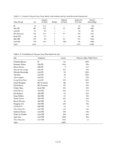
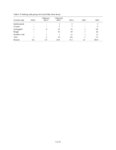
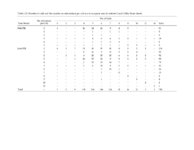
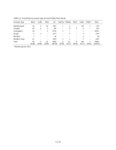
Show are continuously reused. Unlike storage pits, this is an attribute shared by all of the NMRAP secondary habitations where this was possible, except for the tiny brush shelter at the late Pueblo II component of Modest House. Middens ranged from 5 to 30 cm in depth, were concentrated in areas less than 5 m in diameter, and typically had maximum artifact counts of less than 30 items per 1 sq m. It is clear from all of the preceding that the field house interpretation does not end with a finding of "seasonality," or dichotomies that partition occupations into short and long term. Various results indicate that small sites, such as field houses, must also be evaluated in light of duration of occupation (including time of occupation), function, and the site's relationship to associated settlement systems. The rank order of field house duration presented earlier is based on qualitative and quantitative differences in the use of the four sites. We believe that the order is primarily related to differing site durations (or perhaps intensity of use), with variability in function playing a minor role. The functional role of some secondary habitations such as The Slots still eludes us, and it may be because we do not have a nuanced understanding of settlement organization and mobility among the Kayenta Anasazi. When we ask ourselves, "What do we mean by field house?" we have set ourselves a challenge-a challenge, as Graham (1994:106) said, "to develop the means by which we can interpret … settlement pattern[s] accurately." Only then will we be able to explain what the "little" sites mean, and what the "big" sites mean in relation to them. Temporary Camps Just three of the NMRAP Puebloan sites were designated as temporary camps. At two of these the Puebloan component was discovered while excavating a buried Basketmaker or Archaic component, and consisted simply of a single hearth with several artifacts. The third site consisted of a Pueblo I artifact scatter around two basin hearths at Wolachii Bighan. Puebloans clearly had a need for temporary camps but perhaps less so within the region of intensive land use, which is what the N16 ROW mostly represents. The Glen Canyon lowlands adjacent to the project area contain a profusion of Puebloan temporary camps (Adams and Adams 1959; Adams et al. 1961; Geib 1989; Long 1966). The sites with single hearths produced too few remains to get any indication of settlement function and the flotation samples from the features were equally uninformative. The meager remains documented at Wolachii Bighan easily fit the deposition of a single use episode or perhaps a few episodes within the span of a few years. The role of the site within regional settlement remains conjectural, but a lack of faunal remains or hunting-related tools or production debris would seem to preclude faunal procurement or processing. The occurrence of a moderately well used metate fragment along with certain macrobotanical remains, most notably abundant fragments of pinyon nutshell and cone scales within a hearth flotation sample, may support an interpretation of the site as a pinyon nut harvesting camp (alternatively, the pinyon remains may have entered the record by burning old cones for fuel). The site today is located within a dense pinyon and juniper forest that produces abundant nut masts during good years, and there is no reason to believe that the situation was any different during Pueblo I times. Habitat proximity is admittedly an inadequate basis for inferring subsistence practices (e.g., Madsen 1981), but upon considering locational data in conjunction with the flotation results and the presence of a metate, pinyon exploitation takes on a degree of plausibility. Excavations at Wolachii Bighan uncovered two use areas, each with a basin hearth surrounded by small scatters of sherds and stone artifacts, mostly chipped stone debris, along with unworked sandstone and limestone chunks. The hearths seem to have been used just once, as there was no evidence that the occupants had emptied the fill of either. Excavations recovered 122 sherds from a maximum of just five ceramic vessels or portions thereof, all jars. If the Kana-a Gray jars were used at the site as whole vessels, rather than as reused pieces, it is probable that they were the only whole vessels ever used at the site. Due to their scarcity and degree of fragmentation, it seems likely that the one Kana-a Black-on-white sherd and the few Lino Gray sherds were brought in as pieces for reuse as some other tool form. The stone artifact assemblage was equally skimpy, with only four lithic tools and 54 pieces of debitage. These meager remains could easily have been deposited during a single use episode or perhaps a few episodes within the span of a few years. Puebloan Mobility Robert Kelly's (1992:60) quote presented earlier about humans using mobility to overcome the fact that no single locale can provide for all human needs, occurs in a paper where he cites archaeological research from the American Southwest (e.g., Gilman 1987; Powell 1983; Precuel 1990) to make a case that mobility patterns in prehistory had been unappreciated until recently. This is certainly true for residential mobility of the type that Binford (1980) explicated, since Puebloans were seen as largely sedentary, V.15.49 |