| OCR Text |
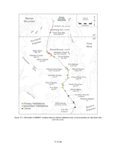
Show cists in the open near the fields or within shelters in the canyons. As such, the lack of storage pits at the sites classified here as secondary habitations does not necessarily count against an overwintering role. There are two problems, however, with such a picture. One concerns the nature of remains at the secondary habitations and the other has to do with the existence of residential sites that seem a far better fit as winter residences-sites such as Kin Kahuna and The Pits. The trash middens at the secondary habitations are inconsistent with an overwinter occupation in that they are small and contain a low density of remains. These deposits are charcoal stained, but the burning of fuel for warmth during the winter months should generate an abundance of charcoal and ash, creating extensive deposits of blackened sediment such as were documented at Kin Kahuna or on the surface of The Pits outside the ROW. The density of remains and their total abundance at secondary habitations is also inconsistent with overwintering. Since such a site would be occupied for several months during a season when time is not overly committed to subsistence pursuits, there would be plenty of opportunity for various arts and crafts, with producing and using flaked stone tools accounting for a significant contribution of artifacts to any midden. The quantity, density, and diversity of stone artifacts from Kin Kahuna stand out as what I would expect for a winter residence, but not the paltry lithic assemblages from any of the secondary habitations. Another issue along these lines concerns the recovery of macrobotanical remains. Even if corn was not stored directly at a winter residence, it would have been consumed there because survival during this lean season depended in large part on stored field produce. As such, corn remains should accumulate at any winter residence, especially since cobs probably would be burned as fuel for warmth or for cooking. Although corn was present at most of the secondary habitations, it occurred in moderately low rates, tending to be found in flotation samples rather than field screening. In contrast to this situation is the high ubiquity of corn remains at The Pits and Kin Kahuna, including the common recovery of kernels and cobs, or portions thereof, during excavation. In sum, it seems highly unlikely that the secondary habitations could have served as winter residences like those of the Havasupai; rather they were likely used during another season (or seasons) and for a shorter duration than the several-month span of an average winter. The only probable candidates for winter residences are the sites classified as primary habitations, which brings me back to the assumption stated earlier, that the Basketmaker habitations excavated for the NMRAP are the differentiated parts of a settlement-subsistence strategy that together with camps and other site types formed an integrated whole. When Kidder and Guernsey (1919:207) speculated that Basketmakers "lived during a large part of the year in the open, where they presumably erected temporary houses analogous to the summer shelters of the Navajo," it is almost as if they had foreseen the secondary habitations excavated by the NMRAP. What Kidder and Guernsey had not foreseen was that many Basketmakers also spent their winters in the open within pit houses. Although secondary habitations were evidently used for only a small part of a year, the presence of moderately formal structures suggests that more than a brief single-use episode was envisioned; thus it seems probable that this type of site was intended for sequential occupancy over several seasons. Internal modifications to structures such as the multiple entryways and hearths at the Panorama House structure are consistent with non-sequential use across several seasons and perhaps the refurbishment of a house after a several-year lapse in use. The N16 swath across the central part of the Rainbow Plateau lacks Basketmaker habitations of any type and although this could merely be a sampling problem, there are reasons to believe otherwise. First, habitations of later farmers are well represented on this part of the plateau, so the area was inhabitable by farmers. Unlike the area of the high divide to the south where almost any brief walk will encounter a small Basketmaker II habitation, no Basketmaker II sites were discovered during reconnaissance walks in the central portion of the Rainbow Plateau. Plenty of sites occur in this area, but invariably they are Puebloan in age, especially middle to late Pueblo III. Finally, the few surveys of this area that have been conducted, though limited in scope, also have not found Basketmaker II habitations. This does not mean that none occur in the area, but certainly far fewer than either on the southeast edge of this plateau or at its northwest edge around the foot of Navajo Mountain. One reason for this could be that settlement of this area would have relied almost exclusively on dry farming. There are small runoff-enhanced settings in a few drainages, but these do not appear to be as optimal as those elsewhere. The Basketmaker population density was perhaps low enough for the area that families could concentrate in more optimal settings, which meant along the southeast edge of the Rainbow Plateau and the foot of Navajo Mountain. The remnants of one Basketmaker II habitation along the east side of Navajo Mountain included in the N16 ROW poorly represents what seems to have been an important area of settlement for these initial farmers of the region. Survey coverage and personal reconnaissance in this area has been sufficient to demonstrate that Basketmaker II sites are quite common. Moreover, this is where there are six excavated or tested Basketmaker II caves. This area is generally lower in elevation than the central portion of the V.14.35 |