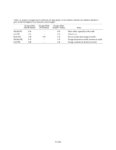
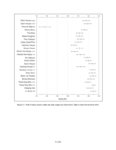
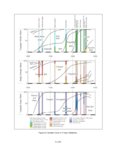
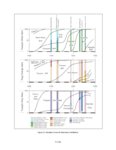
| OCR Text |
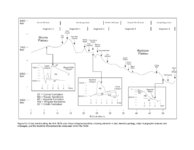
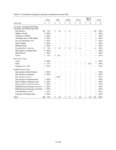
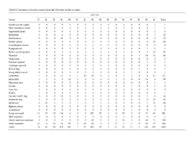
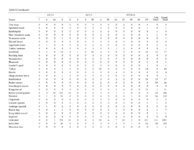
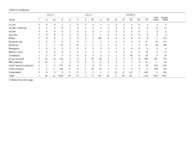
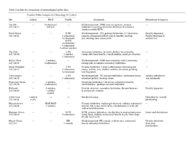
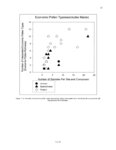
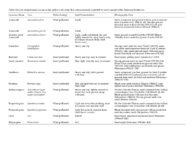
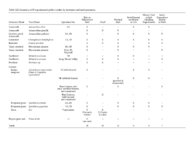
Show 4 from native grass seeds (documented in Chapter 12) show that grass is one of the better pollen types for preserving a pollen signal of deliberate manipulation. N16 ECONOMIC POLLEN TYPES The only clear cultigens in the project samples were maize and squash, and squash was rare, occurring in only 3 of the 287 project samples. In this analysis, a core list of economic pollen types was developed, based on the results from intramural samples and the plants repeatedly identified in regional archaeobotanical studies (see literature referred to in the previous paragraphs). The two most common plant resources, other than maize, interpreted from the pollen data were grass and Cheno-Am. Other pollen types interpreted to represent important economic resources are pinyon pine, juniper, Mormon tea, buffaloberry, sunflower family, prickly pear, beeweed, and cattail. Rare economic pollen taxa inferred from project samples include parsley family, skunkbush/sumac type, cholla, walnut, and rose family. Pinyon and juniper, the common trees in the region, were crucial resources for fire wood, construction wood (and boughs), pinyon nuts and juniper berries for food, and pinyon sap for a variety of waterproofing and sealing jobs. Mormon tea and buffaloberry are both local shrubs with a variety of uses. Mormon tea is widely known as a medicinal plant (Moerman 1998), and in the Rio Grande pueblos, Dunmire and Tierney (1995:123) report that it has been used as a cough medicine, for urinary disorders, and a skin wash, and, because of the tannin in Mormon tea, it has also been rendered to a powder that was used to tan hides. Ashes from burned buffaloberry wood were used for medicinal and ceremonial purposes in the Southwest, and the berries of several species were widely used for food (Moerman 1998:528-530); the dried berries from several species of buffaloberry were also an important trade item, as well as a lucky charm (Moerman 1998:528-530). Beeweed was another important subsistence plant, and a recent comprehensive summary of the ethnographic information on beeweed has been compiled by Adams et al. (2002). The whole plant, stalk, roots, leaves, flowers, and roots have been used for food, medicine, and ceremony. Beeweed could be dried and stored, either before or after cooking, which increases its utility. Beeweed seeds have been identified in human coprolites-clear evidence of the use of this resource for food (Fry and Hall 1975:89)-but one of the more extensive uses of beeweed was for a black pottery paint. Adams et al. (2002:347) found ethnographic references to beeweed dyes for seven Southwest Indian tribes. Archaeological evidence of some subsistence plants is more visible through pollen than macrobotanical remains. Cattail and cacti are examples of resources that are resolved better by pollen, because there are few hard parts to preserve from these plants. All of the cacti were important because these plants were dependable resources, even during drought, and flowers, fruits, and young vegetative parts could be dried and stored. Prickly pear pollen was notable at specific sites in the N16 samples, and cholla pollen was also present, but rare. There is extensive information on historic use of prickly pear pads and fruits for food and medicine and cholla flower buds and fruits for food (Mayes and Bayless Lacy 1989; Stevenson 1915; Whiting 1939). The use of cattail has been underestimated in the Southwest because often only macrobotanical analyses are completed, and cattail is more visible through pollen analyses. Every part of the cattail plant is edible-roots, leaves, the cattail spike, and even the pollen (Moerman 1998:573-576). Another important use of cattail is as a source of fiber for basketry, building thatch, mats, and ties for other materials (Moerman 1998:573-576). ENVIRONMENTAL POLLEN Modern Pollen Spectra and Analogs Modern vegetation along the N16 road alignment changes from a dense pinyon and juniper woodland in the southeastern portion of the Rainbow Plateau to sagebrush sand flats in the north portion of the plateau; around the base of Navajo Mountain at the north end of the road, sparse pinyon and juniper forest with blackbrush (Coleogyne) is the dominant vegetation. Within these broad community categories, there are variations that reflect changes in aspect and substrate, and along the washes and in adjacent canyons, there are stringers of riparian and other mesic plant associations. Thus, in evaluating archaeological pollen assemblages, the structure and composition of modern vegetation near each site is considered in conjunction with the pollination ecology of the dominant species (see above, Limitations of Pollen Data). In the ideal pollen study, an analog of the natural background pollen rain is developed and compared to archaeological assemblages, and unique assemblages are identified. In reality, modern analogs reflect, to varying degrees, unnatural landscapes modified in the last two centuries from overgrazing, mining, manipulation of surface water, and other extensive resource extraction and land use V.1.4 |