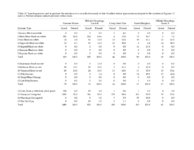
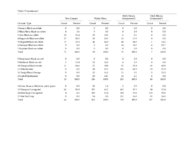
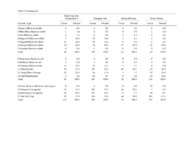
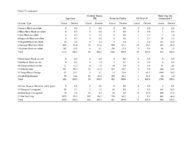
| OCR Text |
Show strategies. Nonlocal stone obtained in this manner generally had higher value than local material only because of desirable intrinsic physical characteristics that made it superior to local material for use in particular artifact types. Based mainly on raw material type, source, and design strategy, a relatively small number of groundstone artifacts appeared to have been obtained through exchange, originating from outside the project region. These trade goods included turquoise ornaments, soapstone beads, and pipes/cloudblowers made of scoria and soapstone. A review of prior work throughout the Southwest shows that prehistoric grinding tool production was generally a non-specialized form of craft production conducted at the individual or household level. Ethnographic information about mano and metate manufacturing among historic Southwestern groups shows that a variety of grinding tool production practices were used. Production was usually conducted at the individual or household level, and most often it was non-specialized, although some instances of craft specialization have been recorded. In addition, although both sexes could be associated with mano and metate production, in some cultures women were more often the procurers of raw materials, the manufacturers, and the owners of these tools. There are, however, a few well-documented cases of prehistoric and historic part-time specialization in the production and exchange of manos and metates. Most of the N16 assemblages lack evidence of specialization in grinding tool production, and for the most part grinding tools were made at the individual or household level for personal or local use during Archaic, Basketmaker, and Puebloan times. Nevertheless, the presence of several in-production manos and metates along with associated production debris concentrated at a handful of Pueblo III sites strongly suggests specialist production and exchange of grinding tools at these sites-at least at a low level. The location of these sites at the foot of Navajo Mountain provided ready access to a highly desirable raw material (Navajo Mountain sandstone) that was well suited for the size and types of manos and metates being used during the Puebloan period. Therefore, although most grinding tool production appears to have been local and non-specialized, there was some degree of grinding tool craft specialization in the Pueblo III period in the Navajo Mountain area. Many N16 grinding tools exhibited use-wear from concomitant secondary uses, some had sequential secondary uses, and a few tools had both types of secondary use. The sequential use of grinding tools suggests that abandoned or broken tools served as raw material for the production of new tools. Several behaviors may account for the presence of redesigned and recycled tools. At N16 sites the most likely causes were lengthy site occupations, reoccupation of abandoned sites, and moving broken or worn tools from primary residences to seasonal residences. Metates were the tools most often reworked into new grinding tools, whereas one-hand manos were the tools most often manufactured from other grinding tools. One-fourth of the one-hand manos also served concomitant secondary functions. Concomitant secondary uses for grinding tools included use as anvils, paint processing tools, and to a lesser extent, hammerstones. Some miscellaneous grinding tools served several concomitant abrading functions. Almost all anvil use-wear observed on stone artifacts recovered from the N16 sites resulted from secondary use of grinding tools. When an anvil was needed, readily available stone tools were usually used rather than obtaining a new stone strictly for anvil use. Most often the tools used were manos and metates. Nearly all the stone tools with anvil use-wear were recovered from permanent habitation/residential camp sites, suggesting that activities requiring anvils most often occurred at these sites rather than at seasonal habitations or temporary camps. It was also observed that the location of anvil use-wear on manos and metates strongly suggests that care was taken to preserve the primary functions of these tools when undergoing secondary use as anvils. This indicates that the women who owned or used the tools were most likely those who used the tools as anvils. Bipolar flaking, a stone tool manufacturing technology widely used by women, is one activity that may account for much, but not all, of the observed anvil use-wear. A few stone grinding tools recovered from the N16 sites were used as paint stones. The diverse locations of pigment-stained tools and the ubiquity of mineral samples suggest that most pigment processing was not a specialized craft, but rather was more likely a task that occurred in most households. Based on the types of tools used it also appears that women might have done much of the pigment processing. SOCIAL ORGANIZATION The final research issue for the N16 project to be addressed in this chapter is Anasazi social organization. Of the specific questions proposed for this topic in the research design, only a few could be adequately addressed with information derived from grinding tool analysis. As pointed out in the research design in Chapter 2 of Volume I, "although artifacts are essential to the investigation of social status and gender, they will not be extensively used for the analysis of social organization." Three areas of information pertaining to grinding tools and miscellaneous groundstone items were examined in an V.6.31 |