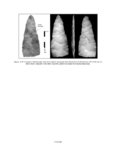
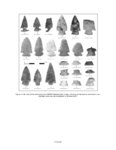
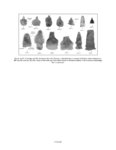
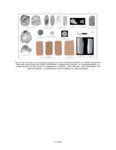
| OCR Text |
Show cultural and is commonly recovered by normal field procedures.4 Flakes exhibit evidence of intentional force application (e.g., ring crack, ripple marks, stressed fracture) and separation from a larger or equalsized piece of material (i.e., they are flakes rather than cores). Flakes also exhibit attributes from either of three types of initiation and propagation-Hertzian cone, bending, or bipolar (wedging) (Cotterell and Kamminga 1979, 1987). Debris with blocky un-orientable fractures were also included as debitage; such angular shatter can result from any of the three general types of flake initiation but are most common with bipolar and simple core reduction. Explicit recognition of bipolar debris results in fewer items classified as angular shatter because a specific reduction technique can be identified. Archaeologists unfamiliar with bipolar flaking doubtless inflate the count of undiagnostic shatter. Any piece of debitage can be used as a tool no matter how it was created or its condition. Such artifacts provide data relevant to both debitage and tools. The analysis of debitage can provide a body of data useful in determining the trajectory of prehistoric human behavior with regard to lithic resource procurement, tool manufacture, and tool refurbishment. This trajectory begins with the selection of raw materials and ends with the deposition of lithic artifacts in the archaeological record. All debitage was analyzed as individual items rather than using some form of mass analysis (Ahler 1986, 1989) or by characterizing flakes in lots. On the recording form each flake constituted a line of data for a series of variables. This approach has been standard for more than 30 years (e.g., Fish 1979; Katz 1976; Magne 1985; Phagan 1980), since it provides highly detailed data linked to reduction techniques and strategies in stone tool manufacture. This information is essential for examining intra-site patterning of reduction activities and for characterizing production technology and lithic resource use among sites and time periods. The debitage analysis focused on a select group of variables that we (and others) have found informative and would be most relevant to the research issues raised in the NMRAP data recovery plan. Besides provenience information (site number, provenience number, bag number, and item number for used flakes), 12 variables were recorded for each piece of debitage as follows: raw material, flake category (inferred reduction technique), debitage condition, cortex amount, size class, weight, type of rejuvenation flake, type of tool fragment/spall, thermal alteration, inferred function for used flakes (coded twice for two potential uses), and coded comments. Appendix I defines the variables and the codes used. Several new variables were created in the computer from the recorded data for different statistical or analytic manipulations. Tools For want of a better term we use "tool" as a general referent for all non-debitage artifacts of stone, including used flakes. These are the objective pieces of artifact production, although some of them appear to be unfinished fragments. We recognize five general classes of stone tools, each of which was analyzed using a separate analytic format, although some of the variables were universal: used flakes, flaked facial tools, cores/nodular tools, grinding tools, and miscellaneous other items. Used flakes are pieces of debitage that exhibit obvious use-wear traces (evaluated under a binocular microscope operating at 6.5x to 40x) but no signs of production modification, simply expediently used flakes. Flaked facial tools are items such as unifaces and bifaces that have been shaped in plan or thinned in section by flaking and have "faciality." The latter means that the tools have flattened cross-sections and a distinct plane of greatest area such that they have just two principal faces. Production flaking on these tools might be quite minimal, as in a unidirectionally edged flake, or substantial as in a bifacially thinned and shaped projectile point. Cores/nodular tools consist of chunks or cobbles of rock that may have been purposefully flaked, that were flaked through use, or that were modified through use in other ways such as battering. These items lack faciality and are usually blocky and heavy. If flaked, the intent was not to achieve thinness or section symmetry, but merely to shape or create a working edge (e.g., pecking stones and cobble choppers) or simply to produce flakes for use (unused cores). This class also includes naturally angular chunks of stone used for pecking or hammering on stone, resulting in battered edges sometimes accompanied by use-spalls of various size. Grinding tools are restricted to manos and metates, items whose principal use was for seed grinding. These include everything from informal expedient manos and grinding slabs to formal, high-production-input items such as bin-type slab metates and two-hand manos. The miscellaneous category includes all other types of modified stone such as ornaments, mauls, pipes, anvils, and abraders. At a theoretical level we are adverse to the common practice in archaeology of separating tools into 4 Debris from pecking may be retrieved in soil samples collected from floor and activity surfaces or trash middens. V.5.7 |