| OCR Text |
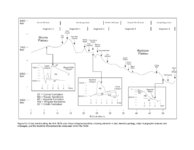
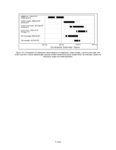
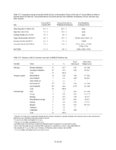
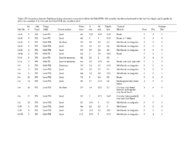
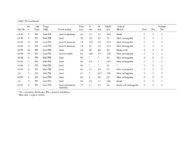
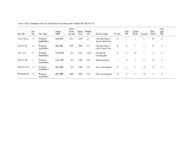
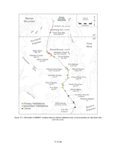
Show mammal bone and much of the rodent-sized mammal bone seemed intrusive (fresh looking). The rabbitsized remains seemed nonintrusive and most of the unidentifiable bone fragments of this size group were burned; all identifiable bone came from desert cottontail, an animal more likely taken by traps or with sticks and not requiring the production and maintenance of projectile points. The two tiny grinding slab fragments, along with the occurrence of goosefoot seeds in the basin hearths, might support the conclusion that the site also served as a temporary camp related to seed collecting and processing, which would seem to accord well with the site setting in a shrub grassland. The limited spatial extent of the remains and proximity of the two hearths might be taken as an indication of a single use episode, but this might have simply resulted because the site setting fostered repeated use of a small area. The recovery of artifacts and bone from the entire 85 cm thickness of the dune sand that comprised the Archaic stratum seems more consistent with multiple use episodes. The radiocarbon dates on the two hearths indicate that they are both more than 8000 radiocarbon years old but are not contemporaneous, so these features also appear to have resulted from two successive uses of the site location. If there were two or more use episodes, there is no way to know which remains (artifacts and bone) are associated with them because the hearths had the same stratigraphic position. For interpretive purposes, therefore, there is but a single composite assemblage and set of features. In this sense, the site is no different from the late Archaic residential camp of Tsé Haal'á, which clearly seems to be the aggregate of many individual use episodes, yet there is a staggering difference in the abundance, diversity, and type of remains. The findings from Dune Hollow seem to accord with specialized transient use, but the presence of grinding tools indicates seed processing, implying food processing and consumption, something likely to occur at a residential camp. If true, then the limited nature of the Dune Hollow assemblage suggests that the site was a different sort of residential base than Tsé Haal'á and distinguishing between these two still has utility, although interpretation of meaning will differ. Settlement Pattern Our understanding of Archaic settlement on the Rainbow Plateau-indeed the Kayenta region more broadly-is hampered by a lack of intensive regional survey coupled with a serious visibility problem. As mentioned previously, the Archaic archaeological record of the N16 ROW and elsewhere across much of the Kayenta region is largely a buried phenomenon. Only three of the Archaic sites were partially exposed on the surface from natural erosion. The other Archaic sites or components were buried and hidden from view and were found either because prior road construction had exposed them or because the Archaic remains fortuitously occurred under a Basketmaker or Puebloan site that was trenched. This same pattern was observed on other recent NNAD road excavation projects on the Kaibito Plateau (Bungart et al. 2004; Neff et al. 2002). The Archaic archaeological record thus appears to be largely obscured from view, especially the portion of it that is most informative because of containing intact features and some preservation of subsistence remains. The problematical nature of trying to use the current record of Archaic remains to talk about settlement practices is perhaps illustrated by the fact that no Archaic sites are reported for the southern portion of the N16 ROW (Schroedl 1989). The upshot is that I cannot make any substantive claims about settlement patterning beyond a few generalizations that reflect little more than common sense based on the limited empirical patterns now known. It should go without saying that statements about Archaic settlement are subject to revision once a substantial portion of both the Rainbow and Shonto Plateaus have been surveyed and a greater number and diversity of Archaic sites have been excavated. With these caveats in mind, it seems reasonable to look at where Archaic sites are concentrated and the possible environmental reasons for why this might be the case. In this regard it is important to state that I assume that the Archaic foragers of the region probably had several general criteria about where to locate their settlements-the same ones Jochim (1976:46-50) identified in his ethnographic overview of hunter-gatherer settlement behavior: "(1) proximity of economic resources; (2) shelter and protection from the elements; and (3) view for observation of game and strangers." Although socio-cultural factors may also be a strong determinant of site placement on a landscape, environmental variables are especially appropriate for understanding hunter-gatherer site location preferences because of the close relationship that foragers have to their environments coupled with relatively low population densities and generally fluid and open social networks. The natural environment structures decisions of site location into a hierarchy of those that are spatially general and those that are spatially specific. Sites are generally located within a region on the basis of one or more resource requirements, mainly those pertaining to subsistence. Decisions about specific site location follow those of general placement and may be predicated on a variety of factors that usually relate to convenience, efficiency, and comfort in daily activities. Localized microenvironmental V.13.41 |