| OCR Text |
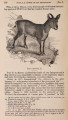
Show 1893.] ON MAMMALS FROM BRITISH CENTRAL AFRICA. 723 and closes more or less in air, because the correction for astigmatism is evidently made for air and not for water. Now our iris dilates when the accommodation is relaxed, and contracts when it is called into play ; and if in the Seal the accommodating mechanism be the same as ours, the above-mentioned changes would obviously only make matters worse. But here again the question is beset with difficulties, for this myopia could only be of service if it were due to the lens, since any curvatures of the cornea would be neutralized by the water. At present my observations go to prove that the iris is to some extent at least under the control of the animal's will, since in one Seal, at any rate, I observed the pupil moving out of all proportion to the accommodation, while, on the other hand, I induced accommodation by approaching a piece of fish without any alteration in the pupil. I hope in a future paper to be able to give some explanation for this extraordinary amount of astigmatism, and although I have a theory I would rather reserve any further attempts at an explanation until I have verified all the facts which bear on the question and examined all objections which can be urged against it. 4. O n some Specimens of Mammals from Lake Mweru, British Central Africa, transmitted by Vice-Consul Alfred Sharpe. By P. L. SCLATER, M.A., Ph.D., F.R.S., Secretary to the Society. [Eeceived November 16, 1893.] Mr. Alfred Sharpe, H.B.M. Vice-Consul in Southern Nyasaland, has kindly sent me some specimens of the larger Mammals which he obtained during his recent journey from the north end of Lake Nyasa to Lake Mweru and the Luapula \ together with a number of flat native skins procured from the natives at Mweru. These I have now the pleasure of exhibiting. In a letter written from Blantyre (28th March, 1893) after his return, Mr. Sharpe gives the following interesting account of the animals met with on his route :- " On the road from Nyasa to Tanganyika almost no game is seen until the Saisi is reached [this river, rising in the Mambwe Country, flows N.E. and E. to Lake Hikwa]. There, for tbe first time on this route from the sea to Tanganyika, one finds the Cobus vardoni, also the Impala (JZpyceros melampus), Roan Antelope (Hippotragus equinus), Lichtenstein's Hartebeest (Bubalis lichtensteini), Eland, Zebra, &c. After leaving the Saisi flats little game is seen on the road thence to the south end of Tanganyika. "I doubt if game can, anywhere in Central Africa, be more 1 See Mr. Sbarpe's paper on this subject, Geogr. Journ. i. p. 524(1893), the accompanying map. |