| OCR Text |
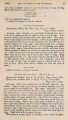
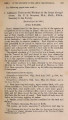
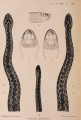
Show 1893.] DR. P. SONSINO ON DISTOMES. 499 embryo alive and swimming in water, but only the embryo coming out from the shell by pressure. In this case the embryo has always died and has often presented the body spoiled and without the ciliar tegument, so that I was only once able to observe a specimen with the cilia in motion. FLUKES OF EXOTIC SNAKES. In a bottle in the collection of parasitic worms in the Museum of Pisa I found, in 1890, a Bistomum obtained from the renal pelvis of Python molurus. I described it under the name of Bistomum simile1, regarding it as a new species, resembling in size and structure B. lanceolatum, with the exception that the two testes, instead of being anterior to the ovary, were situated behind that organ. Other examples of a similar Distome, obtained from the liver of an animal of the same species, I thought, but could not be certain, owing to decomposition of the specimens, might also be Bistomum simile. At the time I could not compare Bistomum simile with the Bistomum horridum of Leidy, because I had not access to Leidy's description. But lately, through the kindness of Dr. Stiles, I have received a specimen of Leidy's Bistomum horridum (obtained from a Boa Constrictor), and from this I have been able to satisfy myself of the identity of B. simile and B. horridum. I have since read Leidy's paper2 describing the parasite, and although in some respects his description is somewhat incorrect, as he speaks of four testes instead of two, and of vitellaria as ovaria, I can recognize in it the identity of Bistomum simile with Bistomum horridum. Another species wdiich appears very similar to B. horridum is the B. sauromatis, described as new by M . J. Poirier. The principal difference between B. simile and B. horridum on the one hand, and B. sauromatis on the other, is that in the latter the two testes are lobate instead of being round as in the former. This variation is so slight that it may merely depend on the diverse habitats of the individuals and not on difference of species. I cannot, however, definitely pronounce on this point, not having at hand a specimen of Poirier's Bistomum, which lives in the lungs of Elaphis sauromates. But the identity of Bistomum simile with B. horridum is very interesting, as it shows that the same species of Bistomum fives in two different species of Snakes inhabiting different countries. DlSTOMUM BARALDII. Bistomum baraldii is a parasite which I have lately described as a new species found in Zamenis viridiflavus3, and which I have 1 See ' Processi verbali della Societa Toseana di scienze naturali residente in Pisa,' Adun, 4 Maggio, 1890. 2 Journal Acad. Natur. Sciences, series 2, i. p. 303 (Philadelphia). D. baraldii, given by m e as a new species, m ay prove to be identical with Bistomum nigrovenosum, Bellingham, found in Tropidonotus natrix. At least my new species much resembles the description and figure given by m y friend Dr. Monticelli of Bellingham's fluke in an unpublished paper with which I have made acquaintance by the author's kindness. |