| OCR Text |
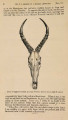
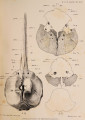
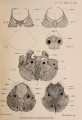
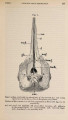
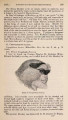
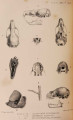
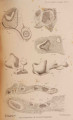
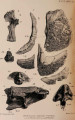
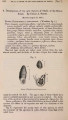
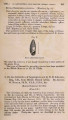
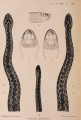
Show 532 DR. C. J. FORSYTH MAJOR ON A LEMUROID SKULL. [June 20, the breast of its parent. Early in the morning of the 22nd day the keeper found the whole family, consisting of the two parents and four young ones, on the ground basking in the sun. " The young birds had beautiful glossy chocolate-brown down, which became almost black on tbe back and lighter on the head. The legs and beak were short and jet-black. " The little birds were wonderfully active and strong, and in the evening they all managed to get up to the nest on the stones, where they passed the night under one of the parent birds. The mother bird was very anxious about the safety of her young, and if anybody approached the aviary a sharp noise she made would quickly send them away to hide" between the stones. If one kept motionless at some distance, the same note but a little softer would call them to the light again. Both parents fed the young in exactly the same way as Cranes do, bringing them ants' eggs, flies, worms, or anything they thought fit, in their bills, which the young would take from them. The little birds, now twelve days old, grow very rapidly ; the legs and neck especially have lengthened considerably, so that they begin to resemble their parents in form verv much. , • " They also have already acquired the habit of jerking their little tails, which of course are nothing but down. The old birds, which were very noisy at all times, even while incubating, and could sing the most wonderful duets, have become perfectly silent since the young were hatched. " The eggs were of a greyish yellow, with dark red and brown spots and lines." . } Mr. Blaauw also stated that one of his female Darwin s Rheas (Rhea darwini) had laid ten eggs, and that the male, after sitting thirty-nine days on seven of them, had hatched three young ones. Dr. C. J. Forsyth Major exhibited a specimen of a subfossil Lemuroid skull from Madagascar, and spoke as follows :- Very recently I have describedx a strange gigantic Lemuroid skull (Meqaladapis madagascariensis, Mai.), discovered by Mr. Last in a subfossil condition, together with remains of Mpyornu, Testudo grandidieri, Vaill., Hippopotamus, A c , in a marsh on the south-west coast of Madagascar. The skull exhibited on the present occasion, found by tbesame collector in a similar condition in the neighbourhood of Nossi-Vey (S.W. Madagascar), is in several respects not less strange, though in'a very different way. Owing to its incomplete state-the whole facial portion being wanting, as well as the right occipital region and basis cranii, and the greater part of the zygomatic arches-it is not possible to enter into many details. The Lemuroid nature of the specimen is at once demonstrated by the great elongation and downward bending of the postorbital frontal processes, the left one of which has preserved the suture for the orbital process of the malar, thus showing that the osseous 1 Proc. Roy. Soc. liii. no. 326. |