| OCR Text |
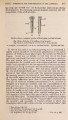
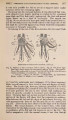
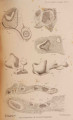
Show 1893.] MR. M. F.WOODWARD ON MAMMALIAN DENTITION. 459 of the latter, they somewhat overlap the lamina connecting the two and it in consequence becomes displaced to the inner side of these structures. So much does the 4th premolar grow forward with age that it appears as if this lamina was a downgrowth from the inner side of the enamel-organ of pm4; this, however, is really not the case, the lamina is morphologically in front of that tooth and only attains a secondary connection with it. A careful examination of the swollen part of this lamina (fig. 16, b) at this more advanced age shows that we are undoubtedly dealing with a developing tooth. N o w the only tooth which develops in this situation is the one successional or replacing premolar of the Marsupials, and this is usually regarded as being the derivative of the 4th premolar, wdiich latter, as far as I have observed, in Petrogale never develops a successional tooth at any time. The successional tooth is here developed from a dental lamina situated between pm3 and pm4, but may aftenvards attain a secondary connection with the latter tooth, but does not represent its true successor. The facts appear to m e to strongly suggest that this tooth represents a premolar belonging to the same series as pm3 and pm4 which has been retarded in its development and in consequence does not cut the gum until long after the others. The further consideration of this point I shall leave till I have described the condition in the other Macropids here dealt with. The condition in the lower jaw is the same as that in the upper. The Molars. While investigating the condition of the developing molars in the Kangaroos I naturally sought to confirm Kiikenthal's suggestion that the molars belonged to the first dentition ; this, however, I have been unable to do. In fact, if any reliance is to be placed on these downgrowths from the enamel-organs of the developing teeth or from the dental lamina, then I must assert that the 1st and 2nd molars of the Macropodidae belong to the 2nd dentition, and that therefore Kiikenthal's original suggestion does not hold good for the Marsupials in general. The great difficulty which we find in connection with the interpretation of the molars arises from the shortness of the jaws, so that according to the age w e find the most posterior molar as yet formed developing side by side with the penultimate one. This led Kiikenthal into a mistake, which he has since pointed out to me. In his paper (no. 5) he figures the 2nd molar of Bidelphys with a rudimentary successional tooth ; this is really, as he n o w believes, the rudimentary 3rd molar developing side by side with the 2nd. He, however, describes what he believes to be a trace of a successional tooth in connection with the 1st molar, but unfortunately he does not figure this structure. I have found no trace of any such structure either in Bidelphys or in Macropodidae, and therefore see no reason to believe that the molars are in any sense referable to the 1st dentition. On the other hand, sections taken across the jaw of Petrogale, |