| OCR Text |
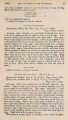
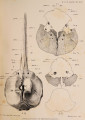
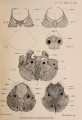
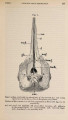
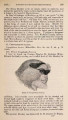
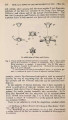
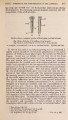
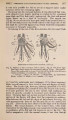
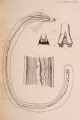
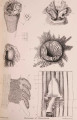
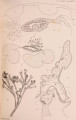
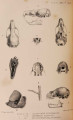
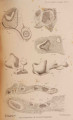
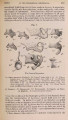
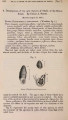
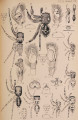
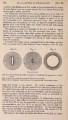
Show 1893.] VERTEBRAL AND LIMB-SKELETON OF THE AMPHIBIA. 271 is liable at all approximate in interest to that of the occasional appearance of transverse processes on the first vertebra; but, with the exception of a casual mention of a case in Rana esculenta by A. G. Bournel, it has remained unnoticed. His specimen was very abnormal in other respects; but I am in possession of two backbones of the same species in which, while the last eight vertebrae were perfectly normal, the first one or " atlas " bore transverse processes, and, in addition (fig. 4 b), a pair of lateral perforations (n of figs. 4b, 10, & 11) disposed serially with the intervertebral foramina. These specimens reached me iu the dried state; but careful examination of the remains of the soft parts which lay about one of them revealed the presence of nerve-fibres within one of the perforations in question, and thus proved it to have transmitted a nerve. On seeking for further light upon this variation, I have dissected certain of the larger Ranoids2 in vain; but m y friend Prof. Chas. Stewart, of the Royal College of Surgeons, has called my attention to the existence of the nerve-exits in the only specimens of Rana catesbiana and R. macrodon which his Museum possesses (cf. figs. 5 b & 9, & 3 & 8), and of powerful transverse processes in the first species named. Strangely enough, neither the skeletons in the Natural History Museum, nor the carcases of these species therein preserved which I have had the opportunity of dissecting3, reveal the remotest traces of either the one or the other. Hyrtl called attention twenty-eight years ago, in his celebrated Monograph on the Japanese Salamander (Megalobatrachus {Crypto-branchus] japonicus), to the existence of a spinal nerve which perforated the arch of the " atlas; " and Humphry, six years later, described the nerve more fully 4 as the " sub-occipital," tracing it to a distribution to the " foremost portion of the sub-vertebral rectus" muscle. Fischer had (in 1864) already described a similar nerve5 in Menobranchus, believing it to be peculiar to that animal among Urodeles; and it is interesting to note that he traced it to a distribution in the "occipitalis minor" muscle. Hyrtl, in accordance with the facts of the case, was led to regard the so-called " atlas " of the Amphibia as a product of fusion of the " atlas and epistropheus " of the higher Vertebrata ; but this revolutionary conception has been almost lost sight of, except for its acceptation by Hoffmann6 and so far as the work of AlbrechtT and Stohr8, alluded to below, may bear upon it. Neither it nor any facts concerning 1 Quart. Journ. Micr. Sci. vol. xxiv. p. 86. 2 Calyptocephalus grayi, Leptodactylus pentadactylus, and Eana yuppyi. 3 For permission to do this m y best thanks are tendered to Dr. A. Giinther, F.E.S., and my friend Mr. G. A. Boulenger. 4 Journ. Anat. & Phys. vol. vi. p. 48 (1870). 5 ' Anat. Abhandlg. ii. d. Perennibranchiaten und Derotremen,' Hft. i. p. 158 (Hamburg, 1864). 6 Bronn's Thier-Eeich, Bd. vi. p. 54. 7 Zool. Anz. 1880, p. 477. 8 Zeitschr. f. wiss. Zool. Bd. xxxiii. p. 477, and Bd. xxxvi. p. 68. 19* |