| OCR Text |
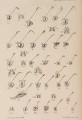
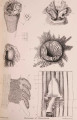
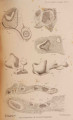
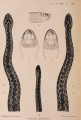
Show 1893.] GENITALIA OF BRITISH EARTHWORMS. 323 cover of that ventral oblique septum running back from mesentery 12/13 and situated just below the ovary (Plate X X I V . fig. 7). Save that this capsule was non-vascular and that no opening into the ccelom could be discovered, it was very suggestive of an additional receptaculum ovorum, the contents especially resembling the condition figured by Beddard for Perichceta 1. At first this structure suggested to m y mind the curious relations between the oviduct and ovary in Eudrilusa; but most careful examination of a complete series of sections failed to reveal a trace of any exit from the ova, the cavity of tbe capsule being closed on all sides. One was thus forced to the conclusion that the organ was merely a ventral extension of the germinal epithelium shut off from the rest of the ovary by the oblique mesentery. The meaning of the special cavity and capsule surrounding this body I am unable to explain. One of the most striking facts arising out of the study of these various specimens is the very marked potentially reproductive character of the posterior faces of the mesenteric septa, especially Nos. 9/10-13/14; for we have seen that it is not at all uncommon to find genital glands developed on all these, and occasionally even on the next 3 or 4 septa following. As a rule, the germinal epithelium is only developed on the anterior wall of each segment (i. e. on the posterior face of the mesentery); but Beddard 2 has, iu Acanthodrilus, described the ovaries as developed on the posterior wall of the segment (anterior face of the mesentery). These facts further accentuate the belief in the inherent power of the entire coelomic epithelium and their derivatives to produce sex-cells. These varied positions of the genital glands suggest the condition met with in many Polychaete worms, where the genital cells are developed from a more or less continuous band of tissue, situated either on the ventral side of the body-cavity, on either side of the nerve-cords, or close round the ventral blood-vessels3. And it seems highly probable that the varying distribution of the genital glands met with in tbe Oligochaeta is the outcome of irregular abbreviation of some such diffuse and possibly hermaphroditic condition under perfected segmentation, rather than of a condition in which the glands were already restricted to definitely metameric-ally arranged centres as in the Planarians. The development of the genital glands in the Earthworms has been worked out by Bergh for Lumbricus and by Beddard4 for Acanthodrilus : the latter author describes the constant presence of four pairs of gonads in the embryo, the additional pair being situated on the 12th segment; this gland, however, never attains any sexual differentiation and disappears early, so that only three pairs of gonads are found in the adult. This rudimentary pair of glands 1 Q, J. M. S. vol. xxx. pp. 448, 471, ph xxix. fig. 12 ; see also Bergh, f. wiss. Zool. Bd. xliv. 1886, p. 318 (footnote) 2 Q. J. M. S. vol. xxx. and vol. xxxiii. p. 514. 3 Cosmovici, Archiv. Zool. Exp. Gen. torn. viii. 1879-80, p. 35V. 4 Q. J. M. S. vol. xxxiii. p. 497. |