| OCR Text |
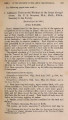
Show 1893.] DR. P. SONSINO ON D1STOMES. 497 Distome belongs to the subgenus Echinostomum, Dujardin, the oral sucker being surrounded by a disk bordered by a circle of spines. Dr. L. Orley, w h o some years ago published an account of the Nematodes from the collection of Prof. Siebold in the M u s e u m l, has not mentioned there the supposed Ophiostomum, therefore we may fairly infer that he had not examined it. In the unique specimen of the worm in question, notwithstanding its rather bad condition, the following characters m a y be verified:- Body flat, elongated, rather narrowed behind; length 7 millim., breadth 2 midim., with the greatest diameter corresponding to the ventral sucker, which is larger than the oral sucker. The latter surrounded by a triangular disk, bordered by spines. The number of these latter appeared to m e to be 24, comprising the 4 lateral and inferior larger. A darker spot behind the ventral sucker is due to the oviduct being full of eggs, which are of large size and not less than 100 micromillim. in length. Yolk-glands rather voluminous from the ventral sucker to the posterior end. Two oval testes at the beginning of the posterior half of the body, one behind the other. Ovarium anterior to the testes. With such characters I suspected that the Trematode was B. trigonocephalum, the ordinary Echinostomum found in mammals ; but before pronouncing myself definitely, I wished to compare the characters of the specimen in question with those of B. trigonocephalum. M y short visit to the British Museum not allowing me to make this comparison there, I made it when I returned home. I found in the collection of the Zoological Museum of Pisa no less than four bottles containing B. trigonocephalum obtained from three different species of Mammals, viz. Mustela foina, M. putorius, and Meles europceus. Thus I had plenty of material to give m e a clear notion of the characters and different appearances of B. trigonocephalum from various sources. I a m now able to say that the specimen of the Trematode of Plecotus communis in the collection of the British Museum is, both as regards size and conformation of the body, as well as the disposition of the spines around the oral sucker, much like B. trigonocephalum. There is also a similarity in the eggs. Only the testes of the Echinostomum in the British Museum appear to be situated rather more behind; but I do not attach much importance to this. Indeed the number of the spines round the head given by von Linstow2 and verified in many specimens by myself is 26 instead of 24. But it is possible that I mistook the number when examining the specimen. I think, therefore, that the specimen in the British Museum is nothing else but B. trigonocephalum. In his ' Compendium,' Linstow does not make mention of such a Trematode as parasitic in any Bat. But B. trigonocephalum has been found in Erinaceus europceus, and it is rather interesting to know that it may also be parasitic in a Bat. Thus it is found in animals belonging to no 1 Ann. & Mag. Nat. Hist. ser. 5, vol. ix. p. 301 (1882). 2 Troschel's Archiv, i. p. 106 (1873). |