| OCR Text |
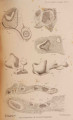
Show 484 MR. F. E. BEDDARD ON THE ATRIUM AND [May 16, genera Pontodrilus, Microscolex, &c. as the lowest forms of the Cryptodrilidae except in the sense that they are degenerate forms; it seems to m e that it is the Eudrilidae which present, as regards the atria, the most obvious likeness to the Geoscolicidae. In them, as in the Geoscolicidae, the atrium opens into a terminal " bulbus " which may even, as in Eudrilus, possess a pad developed out of its lining epithelium apparently not unlike the " scudo ovale" described by Rosa ; the glandular appendix which in the Eudrilidae opens into this is sometimes (as in Heliodrilus) hardly differentiated, as it is in many others, into a muscular and a glandular portion. In Eudrilids the position of the pore of the sperm-duct into the " appendix " is so' variable that there is no difficulty in comparing the two families in respect of the fact that in both the sperm-duct opens into the glandular appendix. Even among the other subfamilies of the Megascolicidae (I am here following Rosa's classification) there are not wanting indications of a close approximation between the atria and those of these Geoscolicids : in some species of the genus Perichceta, for example, the atria open into a sac variable in size, which itself opens on to the exterior; it appears to me that this sac is the equivalent of the terminal sac in the Geoscolicidae. As to the presence of a retractor, which Rosa thinks distinguishes the atrium of the Geoscolicidae, many Megascolicidae have bands of muscles which appear to me to be perfectly comparable; for instance, in m y genus Octochcetus (9) among the Acanthodrilids there are bands of muscles which, though perhaps not exactly inserted on to the atria, are attached to the body-wall in their immediate neighbourhood. A better example still is furnished by two species of Eudriloides lately examined by m e ; in these there are a series of muscular strands actually inserted on to the muscular termination of the two atria. To assert that these are in their nature different from those of the Geoscolicids seems to be too strong. It seems therefore that the facts allow of no other view save that the ATarious structures termed atrium by myself are homologous. The extremes are united by too complete a series of intermediade forms to permit of any doubt upon the point. There are, however, as has been pointed out, differences in detail between the atria of different groups ; these amount to so much in the entire series that the complex gland of Eudrilus, or Perichozta, would perhaps unhesitatingly be regarded as different from the simple atrium of Stglodrilus, were there no intermediate stages. Though there would appear to be no great difficulty in deriving the atrium of one family from that of another, it is not so apparent which are the ancestral and which are the derived forms. To determine or attempt to determine this, opens up the whole question of the classification of these Annelids ; and in my opinion a consideration of the facts relating to the atria confirms for the most part the scheme of classification adopted by myself. In-order to determine which form of atrium is most primitive, it is necessary to enquire into the origin of the atrium. |