| OCR Text |
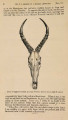
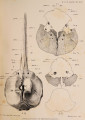
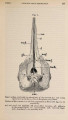
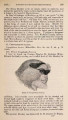
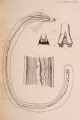
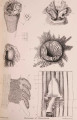
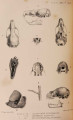
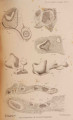
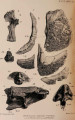
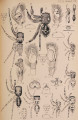
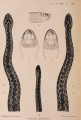
Show 1893.] CETACEAN GENUS MESOPLODON. 233 groove in the three specimens of the younger group are in their greater extent formed by the spout-shaped vomer, by a diverticulum of the maxillary bone (which appears superiorly for a short distance opposite the premaxillary foramina between the vomer and the premaxillary laminae), and by the premaxillaries. As the vomer terminates at 3 inches from the tip of the rostrum, the anterior portion of the spout is entirely formed by the premaxillaries. The empty vomerine trough (in the macerated skeleton) shows no signs of the cartilage, which occupied it in the living state, having been attached at any point to any of the bones, except the anterior termination of the ethmoid, which is rough as is usual. In the previous part of this paper I have shown by sections what takes place in group 2 ; how, probably by the vigorous growth of the maxillary and premaxillary bones surrounding the vomer, a slight upgrowth, as a ridge-like elevation, appears in the bottom of the vomerine trough, and a thickening of the sides of the interior walls of the premaxillaries takes place, which gradually increases and eventually fills up the mesorostral groove. Where the gibbosities occur, over the regions where the vomer does not protrude on the palatal surface, this growth has more space and better resists the pressure, while iu those parts where the premaxillaries approach closer together, the increasing vomerine growth indicates by its varied contortions the effect of the strains to which it has been subjected. The form, therefore, that the rostrum may eventually assume in the mature animal varies with the difference in the strains it undergoes, through the different rate of growth in the surrounding bones, and in the individual's vitality, sex, and age. The various sutures and lines which are seen on the surface of the solidified rostrum of aged crania have already also been explained. In none of the three specimens of group 1 has the buttress (formed by the maxillaries, palatines, and pterygoids) extended sufficiently far forward or become prominent enough to appear externally to the flanges of the basirostral groove. In the oldest specimen I have examined, that from Kaiapoi (I) (Plate XIII. fig. 1), the buttress and the lower margin of the basirostral groove are very prominent, and resemble closely M. australis of Flower, which is also an adolescent individual. On comparing the whole series, it is to be seen that the younger the age, the less anteriorly does the buttress extend, and the less prominent are both it and the inferior flange of the basirostral groove. Seen from the side. The boundaries of the basimaxillary groove are formed by flanges of the maxillary. Their disposition as seen from the upperside has already been described. In the young specimen (A) (fig. 1, p. 221) in the Otago Museum and in Van Beneden's figure, the maxillaries run along the side of the rostrum, in the former to within 2-5 inches, and in the latter to within 3-5 inches of the apex ; indeed, in the latter it appears to be, at 7 inches from the tip, still A of an PROC. ZOOL. Soc-1893, No. XVI. 16 |