| OCR Text |
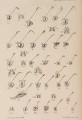
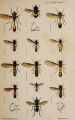
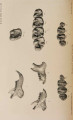
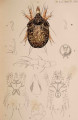
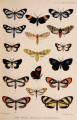
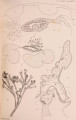
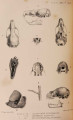
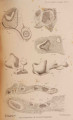
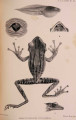
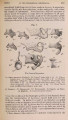
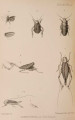
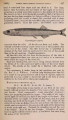
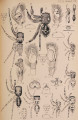
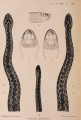
Show 1893.] MR. E. E. AUSTEN ON NEW DIPTEROUS INSECTS. 161 portion of the spurious vein is bright ochreous, tinging the adjoining portion of the wing; the kink in the third vein is angular, and situated slightly before the middle of the first posterior cell. Brazil, region of the Amazons (Bates): five specimens. This species is closely allied to Salpingogaster pygophora, Schin., but differs from it in the colour of the sides of the thorax and in that of the scutellum. In the colour of the scutellum and the markings of the dorsum of the thorax it agrees with Salpingo-gaster nigra, Schin., but differs from that species in the face being wholly yellow, as also in the colour of the sides of the thorax, of the femora, aud of the tibiae, and in the peculiar shape of the external genitalia of the d , in which it agrees with S. pygophora. SALPINGOGASTEE MINOR, sp. n. (Plate V. fig. 4, § .) 2 • Length 12 m m. Thorax ochraceous above, dull, with three dull black stripes; pleura? shining ochre-yellow, a narrow brown stripe running from the base of the wings to the middle coxce, and an indication of a broader and darker but shorter one on each side of the metanotum ; the metanotum not infuscated ; scutellum yellow, the disc brown ; abdomen ochraceous, base of first segment yellow; second segment with a faint reddish-brown band on the basal third; the central portion of the fourth, fifth, and sixth segments, and of the posterior half of the third, dark brown; the darker area is, however, not sharply defined, and may be due to drying or to matter contained in the abdomen. Wings with an ochraceous tinge, which is deeper in the costal cell; subcostal cell tawny, the marginal cell, the distal third of the submarginal, the space between the kink in the third vein and the terminal portion of the fourth vein closing the first posterior cell, as well as the space outside this and outside the discal cell, brownish; the basal half of the spurious vein ochre-yellow, tinging the adjoining portion of the wing; the kink in the third vein rounder than in S. virgata, and situated slightly beyond the middle of the first posterior cell; the posterior cross-vein nearly straight : alulas rudimentary. Legs pale yellow, the posterior femora and tarsi ochraceous ; none of the femora are grooved beneath, but the posterior pair have a double row of short thin spines underneath towards the tips ; the middle femora have no angular process at the tip beneath. The head is considerably flattened antero-posteriorly ; face and cheeks wholly pale yellow, shining, facial tubercle small, sharp ; proboscis ochraceous; antenniferous projection well-marked, shining black on the sides and above; the posterior third of the front, including the ocelli, which are remote from the vertex, shining black; the antenniferous process is connected with this by a triangular patch, the base of which, resting on the antenniferous process, as well as a narrow median line, is metallic black, the rest dead black; on each side of the front below the ocelli is a narrow yellow stripe, running into the yellow of the face ; antennce ochra- PROC. ZOOL. Soc-1893, No. XI. 11 |