| OCR Text |
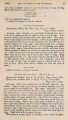
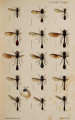
Show 1893.] MR. E. E. AUSTEN ON NEW DIPTEROUS INSECTS. 143 on each side below; yellowish pollinose above in d ? and with a triangular patch of yellow pollen on each side in the middle in the 2 , scarcely separated by an indistinct black median line. Antennas orange-yellow; third joint oval. Front and face in both sexes clothed with very short pale yellow pile. Occiput yellowish pollinose, with a fringe of silvery yellow hair. Thorax metallic black, clothed on dorsum with very short appressed golden pile. Humeri, an elongated spot from thence to the suture, a vertical stripe and rounded spot below the sutural end of this, and two oblique elongated spots below the base of the wing, and separated by a fine line, yellow. Post-alar callosities reddish brown, sometimes darker. Scutellum wholly yellow, but sometimes semi-translucent behind, or more or less distinctly brownish on the disc. Abdomen cylindrical at the base, expanding rapidly and spatulate (especially in the § ) from the base of the third segment: general colour reddish yellow, polished, with very short pile; third and fourth segments with conspicuous black hind margins; first segment reddish yellow, with erect pale yellow pile on each side; second segment cylindrical, reddish brown, darker at the distal end, with a yellowish band occupying the second fifth of its length from the hind margin ; third segment yellowish at the immediate base, with a reddish-brown triangular patch on each side (especially distinct in the § ) narrowly reaching the hind margin, then yellow, except the hind margin, which has a sharply defined black band ; the yellow area of the segment is consequently triangular, with its apex directed forwards; fourth segment yellow, the basal angles, sides, and a large somewhat triangular area on the hind margin with its apex directed forwards, black (the sides of this and the previous segment in the d are usually curled round ventrally, and to be seen must be looked at from beneath); fifth segment yellow, with a blackish median basal spot, indistinct in the d : d genitalia reddish yellow, projecting. Legs yellow ; coxae blackish at the base; an ill-defined band on the distal half of the posterior femora, not reaching to the tip ; distal half of the posterior tibiae, and base of first joint of the posterior tarsi, brown. Wings suffused with brownish ; costal border to the termination of the third vein brown, darkest in the outer portion of the subcostal cell and at the tip : alulas of about half the normal size. Ceylon, neighbourhood of Trincomali (Lieut.-Colonel Yerbury); Mulmein (type); Sarawak (Wallace). Colonel Yerbury obtained five specimens, three of which he has presented to the Museum. H e states that the species is rare. The d which I have described was taken at Kanthalai, March 8, 1892 ; the 2 at Kottawa, April 24, 1892: the third specimen presented is a d, also from Kanthalai, Jan. 31, 1891; the other two individuals obtained are a d and 2 •> the former from Bentota, June 6, 1890, and the latter from Huldamulla, June 10, 1892. Baccha gratiosa, Big., from Sarawak, and B. vespasformis, Dol. (Natuurk. Tijdschr. Ned. Ind. xiv. p. 411, pi. iii. fig. 1), from Amboina, are allied to this species. The latter resembles it very |