| OCR Text |
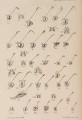
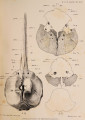
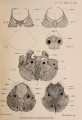
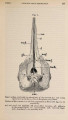
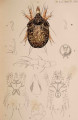
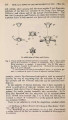
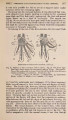
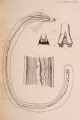
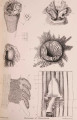
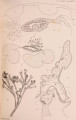
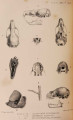
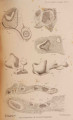
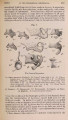
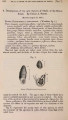
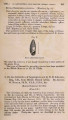
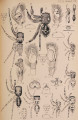
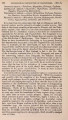
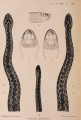
Show 328 MR. A. E. SHIPLEY ON THE GENUS SIPUNCULUS. [Apr. 18, an irregular edge. The extent to which it is developed, however, varies remarkably; it may form but a simple ring (Plate XXVI. fig. 6) as in S. tessellatus, or it may be bent in, thus forming a double horse-shoe, open in the middle line dorsally, or finally it may be again bent out as shown in Plate X X V I . fig. 5. This is the most extreme case I have as yet met with in the arrangement of the ciliated membrane round the mouths of members of this genus. In Sipunculus indicus the head is followed by a short neck, from \ to \ an inch long, which is covered by a number of flattened scale-like papillae, which are bent back, and lie over one another like tiles on a roof'(Plate X X V I . figs. 4 & 8). Behind tbe head the body is conspicuously ringed. The skin presents the usual layers of tissue. Within it is clothed by a layer of peritoneal epithelium ; then come the longitudinal bundles of muscle-fibres, 38 to 40 in number (Plate X X V. fig. 2, and Plate X X V I . fig. 8), but decreasing posteriorly by the fusion of neighbouring bundles. At the extreme hindermost end the bundles fuse into a ring, and in this region the cuticle is thickened and hardened. The circular muscles which lie outside the longitudinal are very strongly marked; several of them correspond with each of the rings which are so conspicuous on the body. Neither in the body nor in the neck do they ever fuse into a continuous sheet. Outside the circular muscle layer is a layer of connective tissue, which is limited externally by a columnar tailed epithelium, the epidermis ; outside this is a more or less thick coating of cuticle. The connective tissue is a gelatinous-looking tissue with cells scattered through it: prolongations of the body-cavity make their way between the bundles of muscles into this layer and in the region of the neck extend into the scale-like processes (Plate X X V I . fig. 8) ; these prolongations are seen in the sections to be circular in outline, and to be lined with a layer of peritoneal epithelium; they contain coelomic fluid, which doubtless serves to nourish the various parts of the skin. The papillae which are so characteristic of tbe skin of Sipunculids are especially common in the scales of the neck of this species. They are not indeed real papillae, as even their mouths do not project above the ordinary level of the skin. They consist of two or three enormously enlarged cells, presumably epidermal in origin, which are crowded with deeplv staining granules ; these are apparently poured out from the apices of the cells which are aggregated together near the mouth of the papilla. Tbe cutis is much thickened iu the region of the neck and forms the substance ot the scale-like projections ; over the rest of the body it is thinner and in places corresponding with the grooves between the rings it disappears almost entirely. It is covered by a uniformly thick cuticle, and numerous papillae are scattered through it, though they are not so abundant as in the neck. The scale-like projections on the neck seem to be characteristic of the genus Sipunculus; no traces of hooks or of the extensile collar, described in Phymosoma, |