| OCR Text |
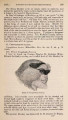
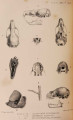
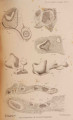
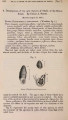
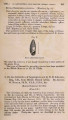
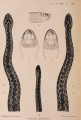
Show 338 MR. O. THOMAS ON MAMMALS FROM CENTRAL PERU. [Apr. 18, each other that their faces form a V in horizontal section, and owing to this and to an apparently greater thickness of the enamel at their outer as compared to their inner margins, their cutting-edges also form a vertical reversed A, the outer corners projecting downwards as sharp divergent points, of obvious use in seizing fish. Molars somewhat of the Habrothrix type, but simpler, with high crowns, and opposite, not alternating, cusps, of which there are six in the first and four in the second molar both above and below, although the two most anterior below tend to fuse into one another. M 3 above and below subtriangular, of average proportional size. Type : I. stolzmanni, described below. " Habrothrix" hydro-bates, Winge, should also be included in the genus. This remarkable new genus is one of very great and special interest, on account of the fact that its members are modified, not merely for an aquatic life, as are many other rodents, but actually for a predacious piscivorous one, almost unique within the order. This fact is fortunately proved without question by the discovery, in the stomach of the Peruvian specimen now before me, of both scales and fish-bones, which have been identified by m y colleague, M r . Boulenger, as those of Tetragonopterus alosa, Giinth., a fish wdth an average length of about six inches. That the habits of Ichthyomys were in some way very peculiar might have been inferred from the striking modification of the upper incisors, of which the sharp separated points would apparently be almost useless for the gnawing phytophagous life of most rodents, whether aquatic or not, while the extreme degree of specialization in the swimming characters would result in an activity and speed under water fully capable of rivalling that of fishes or batrachians, and very different from that of ordinary water-rats. Fiber, however, and Hydromys, of Myomorph rodents, are also both about equally endowed with swimming-powers, and although both are primarily plant-eaters, yet the former certainly occasionally captures and eats slow-swimming fishes L, and perhaps the latter also will prove to do so, especially as it has a tendency towards the peculiar double-pointed character of the upper incisors present in Ichthyomys, and also a very decided resemblance to it in the general shape and structure of the skull. At the same time neither of these forms has the peculiar physiognomy of Ichthyomys, whose general expression bears a considerable resemblance to that of such exclusively fish-eating mammals as Lutra, Myogale, and Potamogale. O n the whole the balance of evidence appears to be in favour of Ichthyomys not being a plant-eater at all, but of its living entirely on fishes, batrachians, crustaceans, or other water animals. Dr. Winge, in the description of his Habrothrix hydrobates, has entered into detailed comparisons of it with many water-mammals, but owing to his specimen having been a skin only, he was unable to make any investigation as to the character and contents of the intestines. But, nevertheless, his placing i". hydrobates in the 1 See Merriam. Tr. L. Soc. New York, ii. p. 187 (1884). |