| OCR Text |
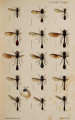
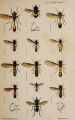
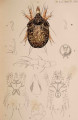
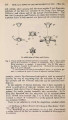
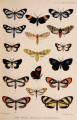
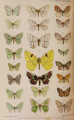
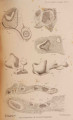
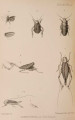
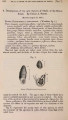
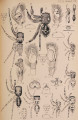
Show 1893.] ME. E. Y. WATSON ON THE HESPERIIDiE. 87 middle one the longer; vein 3 more than twice as far from 2 as from 4 ; vein 2 considerably nearer to base of wing than to vein 3, and about twice as far from end of cell as from base of wing. Hind wing : outer margin sinuate ; middle discocellular very faint, almost erect, lower well developed, outwardly oblique ; vein 5 wanting ; vein 7 considerably nearer to 6 than to 8; vein 3 just before end of cell; vein 2 nearer to base of wing than to vein 3. Hind tibise slightly fringed and with two pairs of spurs. In the male there is on the fore wing a linear glandular streak lying above the central portion of vein 1, and a second double streak lying on both sides of the basal half of vein 2 ; on the hind wing the basal half of veins 2 and 3 and the portion of the lower margin of the cell lying between them are much swollen. On the underside of the fore wing also there is a patch of erect hairs extending from vein 1 to the inner margin, and the hind wing above is thickly clothed from its base with long hairs which conceal the swollen veins. Abdomen conspicuously tufted above. f thyrsis, Fabr 1. Xpandia, Moore. Confined to Southern Asia. 29. Genus SANCUS. (Plate II. fig. 9.) Sancus, de Niceville, Journ. Nat. Hist. Soc. Bombay, vol. vi. no. 3, p. 395 (1891). Type, subfasciatus, Moore. ? Psolos, Mabille, M S . ? Type, pulligo, Mabille. Antennse : club elongate, tip acuminate, recurved. Palpi: second joint densely scaled, third joint almost concealed. Palpi and antennse as in Kerana. Fore wing much elongated. " Male with a curious impressed elongated oval brand placed so immediately behind as to touch the median nervure." Veiu 11 of the fore wing strongly deflected upwards soon after its origin and touching the costal nervure for a short distance; vein 5 nearer to 4 than to 6 ; middle discocellular longer than lower one. Allied to Kerana, Astictopterus, Iambrix, and Koruthaialos. From the three former it may be distinguished by the confluence of veins 11 and 12, and from the latter by the differently formed palpi. (pulligo, Mabille 1. \ subfasciatus, Moore. [ ulunda, Plotz. ) fuscula, Snellen 2. X celunda, Staud. There has been some doubt about the correct synonymy of the species of this genus, chiefly owing to Heer Snellen having stated that the characteristic " male mark " of the genus is wanting in fuscula. The courtesy of the Hon. Walter Rothschild has, however, enabled m e to examine four males and one female of undoubted fuscula, collected in S.W. Celebes by Mr. Doherty, and I find that the males have the " male mark " as in pulligo, though it is much |