| OCR Text |
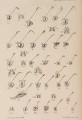
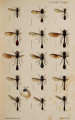
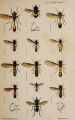
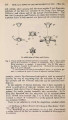
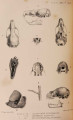
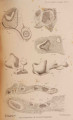
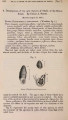
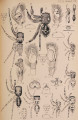
Show 1893.] ME. E. E. AUSTEN ON NEW DIPTEEOUS INSECTS. 147 concave posteriorly, on the hinder half of the segment, widely separated, however, from the posterior margin ; in front of the black band is a small elongate and somewhat oblique yellow mark on each side, between which a narrow median dead-black stripe runs forwards from the cross-band, and bifurcates anteriorly; third segment similar to the second, except that the lateral yellow dots are more quadrate and less oblique, and that the median dead-black stripe does not bifurcate in front, but has a club-shaped head, which touches or is narrowly separated from the anterior margin of the segment; the fourth segment is shorter and broader than the third, but is similar to it, except that the yellow marks, which are duller and not so sharply defined, and sometimes indistinct, are considerably larger and elongated longitudinally ; fifth segment wholly metallic black; genitalia metallic bluish black, small. The abdomen is sparsely clothed with very short black pile. Legs : anterior pair brown, darkest on the tarsi, which are flattened ; the femora at the extreme base and at the tip, the tibiae at the base and at the extreme tip, yellow ; the femora are also yellowish in the middle on the inside; second and third pairs of legs blackish brown, the tips of the femora, bases of the tibiae, and extreme tips of the middle tibiae, yellow : the middle femora have a fringe of dark hairs, the posterior coxae a fringe of pale yellow hairs beneath. Wings uniformly pale brown, except the subcostal cell, which is dark brown. Halteres orange. Brazil, region of the Amazon (Bates): three males. This species is allied to Baccha brevipennis and B. rugosifrons Schiner (Reise ' Novara': Diptera, 341) and to B. stenogaster, Williston (Trans. Amer. Ent. Soc. xv. 266); it is, however, distinguished at once from the two first mentioned by the yellow spots on the abdomen and by the infuscated wings, as well as by its dark legs in the case of rugosifrons, and from stenogaster by its infuscated wings and dark legs. BACCHA BIGOTI, nom. nov. Syn. Baccha apicalis, Bigot (nee Loew). Bigot's species was described from Brazil (Ann. Soc. Ent. Fr. 6 se'r., t. iii. p. 334, 1883); Loew's from Japan (Wien. ent. Monatschr. Bd. 2, p. 106, 1858). The alulas are about half the normal size, with a straight posterior edge. BACCHA INCOMPTA, sp. n. (Plate IV. fig. 13, d •) d • Length 10 mm. Metallic dark brown, nearly bare: wings hyaline, the costal and subcostal cells, a someivhat zigzag mark from the first fifth longitudinal veins, crossing the origin of the third involving the cross-veins at the tip of the posterior based blotch at the tip of the submarginal cell, slightly overflowing the marginal, brown ; alulae of the full size. Face and cheeks metallic steely blue; the former without a 10* |