| OCR Text |
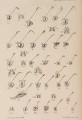
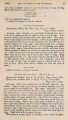
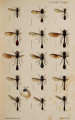
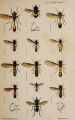
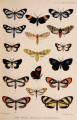
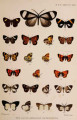
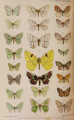
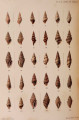
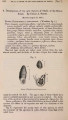
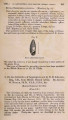
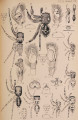
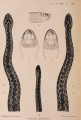
Show 1893.] SPECIES OF MOTHS FROM INDIA. 387 ORTHOCABERA BRUNNEICEPS, sp. n. (Plate XXXI. fig. 23.) 3 2 • Besembles 0. sericea, Butler, from Japan, but larger, with all the markings much more strongly expressed; head, face, and palpi all brown. Hab. Sikkim. [I have this from Messrs. Gammie and Knyvett, taken in spring, aud one from Mr. Dudgeon marked February. Mr. Doherty took it in the Karen Hills in March. It seems to occur at about 5000- 7000 feet. It is a very distinct, well-marked species.-H. J. E.~] MICRONIDIA (?) SUBPUNCTATA, sp. n. (Plate XXXI. fig. 11.) 2 • Fore wings silky white ; costa speckled with brown stria? ; 4 transverse pale olive lines ; the second, as usual, the broadest, in the middle of the wing beyond the cell-spot, which is a distinct blackish dash : 4th line olive, parallel to hind margin, broader and more distinct than in simpliciata ; 1st and 3rd very slender, the olive tints much interrupted, but marked on each vein by a black dot; the basal line preceded by 2 or 3 transverse dark stria?; a strong black basal line before the fringes, distinctly interrupted on the veins ; fringes tinged with olive. Hind wings the same, but without the 1st line ; the other 3 meet towards the anal angle, before which are 2 large black spots; inner margin also pale olive. Head aud thorax white, tinged with pale olive ; abdomen entirely pale olive. Underside white, with the costal stria? and cell-spot darker, the other markings showing through. Hab. Sikkim. In these examples the antenna? are subserrate and ciliated; it is therefore probable that those of the 3 will be found to be pectinated. [I took one specimen myself at Tonglo and have two others from the interior, all females.-H. J. E.~\ MICRONIDIA UNIPUNCTA, sp. n. 2. Fore wings pure creamy white, with 4 straight pale olive-ochreous streaks. Costa with a few irregularly disposed dark stria?. The first line is nearer the base than in simpliciata, Moore ; the second, the broadest, is before the middle of the wing, and includes the cell-spot, which is very faint and lies on the outside edge of the fascia; the 3rd is straight like the 2nd and not waved as in simpliciata; all these three run parallel to one another, slightly inclined outwards ; the 4th band is narrower and parallel to the hind margin, therefore inclined at a slight angle to the 3rd; none of the 4 lines touches the costa ; a fine black line at base of fringes, attenuated at the end of each vein. Hind wings without 1st line ; 2nd and 3rd as in fore wings; 4th, edged distinctly with brown externally, runs from the extreme apex to before the anal angle; space beyond it to the hind margin whiter, containing only 1 black spot above anal angle ; fringe-line very fine and interrupted. Head, face, thorax, and abdomen silky white. Underside all white, but with the markings of the upperside showing through. |