| OCR Text |
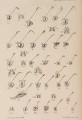
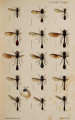
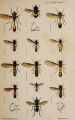
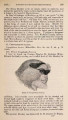
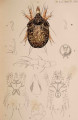
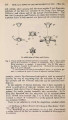
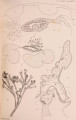
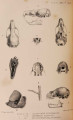
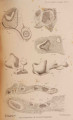
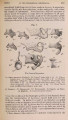
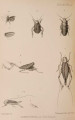
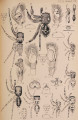
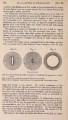
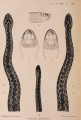
Show 696 MESSRS. G. W. AND E. G. PECKHAM ON [Nov. 21, no fringe of hairs on the underside. The spinnerets are long and pale, the outer ones having a dark line along the external side. A common species. The two species of Cybele may be distinguished from each other by the following points:-In C. vincenti the thoracic part slants steeply from the dorsal eyes, while in C. obscura it falls gradually at first; in G. vincenti the falces of the male are oblique and diverging, in C. obscura vertical and parallel; and in G. vincenti the palpus of the male has the tarsus twice as long as the tibia and not much longer than wide, while in G. obscura it is three times as long as the tibia and twice as long as wide, projecting for some distance beyond the bulb. CYBELE VINCENTI, sp. nov. (Plate LXI. figs. 4-4 d.) 3 . Length 6. Length of cephalothorax 2-8; width of cephalothorax 2. 5 . Length 6*5. Length of cephalothorax 2*5 ; width of cephalothorax 1*8. Legs, 3 1, 4, 3,2, $ 4, 3,1, 2. The first leg is stouter than the others and, in the male, is longer than the second by the metatarsus and tarsus. The cephalothorax has its sides nearly vertical in front and slightly rounded out in the thoracic part; it is widest, as well as highest, at the dorsal eyes, and from this point it falls quite steeply, the slope being slightly rounded out. The first row of eyes is a little curved; the lateral eyes of this row are relatively a little smaller than those of obscura. The dorsal eyes are a little larger than the lateral and are placed on the sides of the cephalothorax, forming a row that is as wide as the cephalothorax at that place. The clypeus is one-fourth as high as the middle eyes of the first row. The patella and tibia of the male palpus are of the same length, and taken together are shorter than the tarsus, which is twice as long as wide ; the palpal tube is very long. The falces of the male diverge widely and have long fangs; they are vertical and rather stout; those of the female are short,' parallel, vertical, and rather stout, with short fangs. The maxilla? are not much longer than the labium. The sternum is almost round. The markings vary considerably in different spiders of this species, and some are much darker coloured than others. The cephalothorax in the male is covered with brilliant red hair and has a snowy white band on each side and another in the central thoracic part. The abdomen is covered with a mixture of grey, red, and tawny hairs; around the anterior end is a curved white band, and from this a central, longitudinal, white band extends backward to about the middle of the dorsum. Sometimes a central band of white figures appears on the posterior half, with two dark rufous spots on each side. The clypeus has a fringe of white hairs on the lower edge. The falces are brown. The legs are banded with lighter and darker brown, the first and second being somewhat darker than the third and fourth. The first leg has |