| OCR Text |
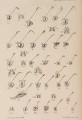
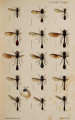
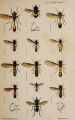
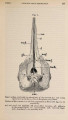
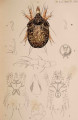
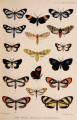
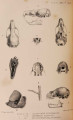
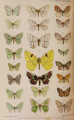
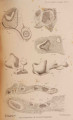
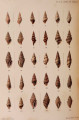
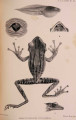
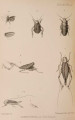
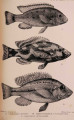
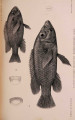
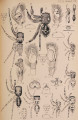
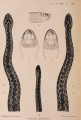
Show 348 MR. W. WARREN ON N E W GENERA AND [Apr. 18 upper angle of cell; 5th subcostal nervule close to the angle, curved upwards at first, so as nearly to touch the common stem of the other 4, then running nearly parallel to upper radial into the hind margin below the apex; common stem of the rest rising at 5 of cell; 1st leaving it just beyond the point where the 5th is approximated to it; 2nd and 3rd both shortly before apex; 4th running into apex itself. Hind wings, $ : with the discocellular vertical, costal and subcostal approximating at a point not far from base, the subcostal branches forking as usual from upper angle of cell, the lower subcostal reaching the hind margin at \- froin interior angle; 1st median nervule only a little before lower angle of cell, 2nd and 3rd together from the angle; radial from the centre of the discocellular. 3 : With the cell much broadened, and somewhat distorted ; 2nd subcostal curving strongly downwards away from the 1st, and reaching the hind margin well below the centre ; discocellular running obliquely inwards from the curvature of the 2nd subcostal; 1st median just before, 2nd and 3rd from the lower end of cell; radial just above the origin of the last 2 ; inner margin fringed thickly with long hairs. Type, Bysethia bicommala, sp. n. The difference in the neuration of the hind wings of the sexes is somewhat analogous to that which occurs in the Larentiad genera Anaitis, &c. DYSETHIA BICOMMATA, sp. n. (Plate XXXII. fig. 1.) 3 2 • Fore wings deep fuscous-brown, sprinkled, especially towards costa and base, with pale lilac scales ; lines blackish :-1st at j runs obliquely outwards, and reaches the inner margin not much before its centre, forming a strongly marked angulation on the submedian; 2nd a little before the middle, forms an irregularly triangular mark on costa only, nearly touching the large oval blackish discal spot; 3rd at f forms a curved, blackish, outwardly pointed costal spot, then a sinuous, pale-edged line to near the anal angle; submarginal line denticulate, formed of pale lilac scales, most distinct towards the costa, where it is preceded by a dark costal patch; fringe fuscous-brown ; basal line of fringes and all the nervules beyond the middle of the wing yellowish. Hind wings of 2 as the fore wings, with a dark brown submarginal curved line; of o* dull greyish ochreous, with a diffuse dark shade in place of the line which is visible in the $ . Head, thorax, and abdomen concolorous with ground-colour of fore wings. Underside dull fuscous, with the exterior hue and discal spots only darker; in the 3, the underside is rather strongly tinged with tawny, especially along the costa ; the 2 , if fresh, would probably show the same tint; in the 3 , owing to the displacement of the radial, the dark discal spot, which is very diffuse, is situate almost at the lowrer angle of the cell. Expanse of wings, 2 38 millim., 3 34 millim. Hab. Sikkim. It is worthy of observation that the pale lilac scales, which are |