| OCR Text |
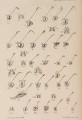
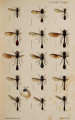
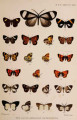
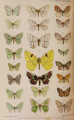
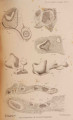
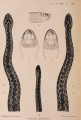
Show 342 MR. W. WARREN ON NEW GENERA AND [Apr. 18, I would refer those who wish to know more of the physical features of the localities in question to my Catalogue of the Butterflies of Sikkim, in the Transactions of the Entomological Society for 1888, and to m y notes on Mr. Doherty's collections in the Society's ' Proceedings' for 1892.-if. J. E.~\ Subfam. CSNOCHROMIN^E. X E N O Z A N C L A , gen. nov. Fore wings with costa gradually curved from base to apex, but somewhat flattened just before the middle; apex produced, blunt; hind margin strongly indented below apex, forming a prominent blunt projection at the end of the 2nd and 3rd median nervules, thence running very obliquely inwards; anal angle rather prominently defined. Hind wings with a small point at end of 2nd subcostal nervule, and a small indentation below it opposite the cell; anal angle squared. Antennae simple, closely laminated, rather flattened ; palpi short, smooth, horizontally porrect, 3rd joint not distinctly separable ; tongue invisible (? absent); legs short, stout, hind tibiae rather thick ; spurs excessively short. Abdomen with slight, oblique dorsal tufts. Neuration :-Fore wings : 1st median nervule at f, 2nd and 3rd close together from lower end of cell; lower radial from a little above the centre of the discocellular; upper radial from upper end of cell; 5 subcostals on a common stem ; the 5th starting halfway between end of cell and apex, and running into hind margin below apex; the 4th into costa before apex; 1st, 2nd, and 3rd at equal distances one after the other. Hind wing: costal approximated to subcostal briefly near base; 2 subcostals from upper end of cell; 1st median nervule shortly before end of cell; 2nd just before end ; 3rd from lower angle; radial from a little above the centre of the discocellular. Type, Xenozancla versicolor, sp. nov. The radials both in fore and hind wings are situated much as in the Geometrince proper, rising above the centre of the discocellular, and not running parallel to the nervules on either side ; but the genus appears to me referable with more propriety to the (Eno-chrominee, in which subfamily are other instances of similar position of the radial of the hind wings. XENOZANCLA VERSICOLOR, sp. n. (Plate XXXII. fig. 17.) 3. Fore wings, towards the base and along the costa, olive-ochreous, thickly dusted with transverse fuscous dots and strigse; rest of the wing dull mouse-colour, with few irrorations ; 1st line black, very indistinct, at $ ; basal area inside of it, more yellowish, less dusted with darker, like the apical costal space; 2nd line represented on costa and inner margin by a black line, curved outward, and between these by 4 black spots on the veins. Hind wings with the 2nd line exactly similar ; the whole basal | mouse-colour dappled with fuscous and reddish brown; the outer third_ less irrorated, and yellowish olive towards the inner angle; fringes |