| OCR Text |
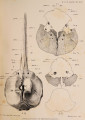
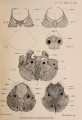
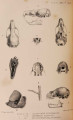
Show 220 MR. H. O. FORBES ON T H E [Feb. 28, is quite possible that further information and more abundant materials may cause a modification of this view '' \ Sir William Turner, in his paper on Ziphius cavirostris and Mesoplodon sowerbyi, in the Trans. R. S. Edinburgh, vol. xxvi. p. 768, says:-"In m y description I have named the dense solid bar in the middle of the beak the mesorostral bone. This bar corresponds with the ' vomer' of Cuvier, Gervais, and Gray, with the ' anterior tuberosity of the vomer' of Fischer, with the ' continuation of the pre-frontals forward to near the end of the premaxillaries' of Owen, and with the 'anterior prolongation of the ethmoid' of Flower. Whatever name be applied to it, there can be no doubt that it is an ossification of the anterior end of the long cartilaginous bar, which in the Cetacea is prolonged forwards to the end of the beak, and in relation to the sides and lower surface of which the spout-like vomer is formed." And Sir William Flower, in the paper I have already quoted from, continues:-"But it must be observed that, although the cartilage appears to be nothing more than a continuation forwards of the ordinary mesethmoid lamina or septum of the nose, the ossification is not a simple extension forwards of that which occurs in all Cetacea (in all Mammalia, in fact) in the hinder or internarial portion of the septum, but appears to be an independent production, peculiar to the genera Mesoplodon, Ziphius, and certain allied extinct forms. It is separated by an interval (which appears to diminish with age, but of which traces can be seen on the upper surface of the rostrum near its base) from the true mesethmoid ossification. It differs from the latter in being intensely hard and compact, whereas the mesethmoid is, especially at its anterior part, somewhat spongy in texture. It differs also in showing strong indications of being formed by a pair of lateral ossifications, united in the middle line, as the upper surface in many parts and the anterior apex show a marked median groove. I think it will be well therefore to adopt Prof. Turner's name of ' mesorostral' bone for this solid bar forming the centre of the rostrum, restricting mesethmoid to the part lying between the nares and a short distance in front of them, which is ossified in the young animal aud in all other species of Cetacea"2. A n examination of the sections of young specimens of Mesoplodon grayi and M. layardi in the light of what takes place in Ziphius cavirostris, Berardius arnuxii, and Clymenia, and perhaps in the fossil genus Choneziphius, will, 1 think, show satisfactorily that the mesorostral consolidation is not an ossification of the mesorhinal or mesorostral cartilage, but is an upgrowth in the rostral trough, formed by a proliferation of the osseous tissue of that part of the vomer itself, and perhaps partly of the premaxillaries, at all events not an ossification of the mesorostral cartilage pure and simple, as occurs in Clymenia and Berardius. Before discussing the question of species, 1 shall trace from 1 Tr. Z. S. vol. x. p. 419. 2 Tr. Z. S. vol. x. p. 420. |