| OCR Text |
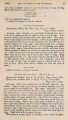
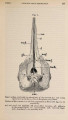
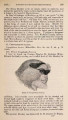
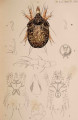
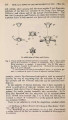
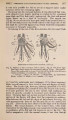
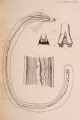
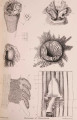
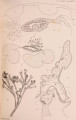
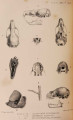
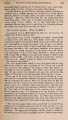
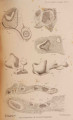
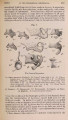
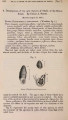
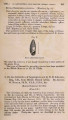
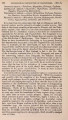
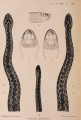
Show 264 MR. A. D. MICHAEL ON A NEW [Mar. 14 are all in one piece and quite hard and stiff; all the claws of Hericia are of this nature. The two hind pairs of legs of the present species have tarsi and claws fairly similar to those of Hericia, except that the shaft is a little more bulbous ; the claws are large, of the ordinary type, and spring from the ends of the tarsi. The two front pairs of legs have an entirely different termination; the tarsi are very powerful, strongly curved downward, particularly at the distal end, and formed of stronger and denser chitin than the rest of the legs ; they end in blunt points, and have the appearance of the dactylopodite in some Crustaceans. They form efficient climbing-organs, and the Acarus practically climbs entirely by their aid. I watched it climbing some dozens of times; it got the curved ends of its tarsi on to or over the edges of small pieces of stone or weed, aud clinging to these slowly dragged itself up. From the side, not the end, of each tarsus springs a long, hyaline, slender peduncle, which projects considerably beyond the tarsus ; this peduncle is flexible in all directions-not in the sense that it yields when it touches anything, for in effect it seldom does touch anything except very lightly, but in the sense that it has special motion of its own and can be flexed and turned in any direction at the will of the creature; indeed, it is almost constantly in motion. The distal end of this peduncle swells suddenly and forms a bulb, at the end of which is a very minute claw; the bulb can be turned upward and downward, carrying the claw, but the claw has not any motion separate from the bulb. This claw and peduncle are not used in clinging or walking at all; they seem to have become wholly tactile organs; the creature clings with the tarsus and then appears to feel about with the claw by turning and bending its flexible peduncle in all directions until it finds a suitable place to put the tarsus for the next step, then it moves the tarsus and the process recommences, being of course done by opposite legs alternately. I am not aware of anything at all similar in the structure and habits of any of the Acarina. I propose calling the genus " Lentungula," and the species L. algivorans. Genus LENTUNGULA1. Tyroglyphidae without marked sexual dimorphism; with the body flattened dorso-ventrally; with the tarsi of the two front pairs of legs strongly curved, gradually diminished, ending in points, and used as climbing-organs. The claws of the same pairs of legs minute and mounted on long flexible peduncles springing from the sides of the tarsi and capable of being flexed at tbe will of the creature. Tarsi of two hind pairs of legs of the ordinary type, ending in large single claws without caruncles. With terminal anus formed of two upright plates lying against each other. Genital aperture in both sexes near the middle of the body between the coxae of the fourth pair of legs. Lentus, flexible ; ungula, a little claw. |