| OCR Text |
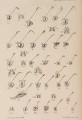
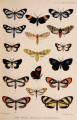
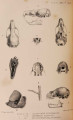
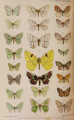
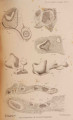
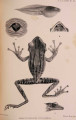
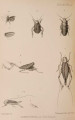
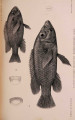
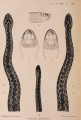
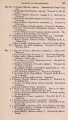
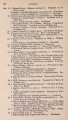
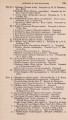
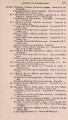
Show 1893.] BRITISH CENTRAL AFRICA, 647 13. YPTHIMA ITONIA. Ypthima itonia, Hewitson, Trans. Ent. Soc. ser. 3, vol. ii. p. 287, n. 11, pi. 18. fig. 13 (1865). Zomba, December 1892 and January 1893. The white areas below vary a little in intensity and the ocelli in size; but in other respects this species seems to be wonderfully constant. 14. YPTHIMA SIMPLICIA. Ypthima simplicia, Butler, Ann. & Mag. Nat. Hist. ser. 4, vol. xviii. p. 481 (1876). Lake Mweru; Zomba, July and December 1892, January 1893. 15. PERIPLYSIA JOHNSTONI, sp. n. (Plate LX. fig. 1.) Wings above cream-coloured ; the transverse striations of the under surface showing more or less distinctly through the wings : primaries with the swollen part of the subcostal vein ochreous ; costal border to subcostal vein, an apical patch continuous with it and extending downwards to first median branch, outer border in the male, and a broad internal border regularly excised near the external angle, blackish; four or five more or less distinct blind black ocelli with orange irides in a straight line across the disk to second or first median branch, three regular parallel submarginal aud marginal black stripes : secondaries with the costa and external border in the male broadly blackish, the latter partly enclosing a submarginal series of black spots ; the three black stripes or lines as in the primaries, but more or less distinctly interlined with white (as in all the wings of the female); female with the costal area more or less smoky grey; a blackish diffused submarginal band, sometimes with excised external sinuations, enclosing a series of more or less distinct ocelli with dull orange irides. Body above black, below cream-coloured, with black striae and three lines on outer border as above; a series of orange ocelli with metallic leaden pupils, five on the primaries and seven on the secondaries (the last two confluent); the central area in the male widely devoid of striation, but in the female the clear space is only represented by an ill-defined fusiform transverse patch or band bounding the ocelli internally. Expanse of wings 37-40 millim. Zomba, January, July, and December 1892. This pretty little species is evidently not uncommon ; it is a link between P. leda and P. panda, the under surface of the female being very similar to that of the latter species, only with more sharply defined black striations. 16. CHARAXES SATURNUS. <S. Charaxes saturnus, Butler, P. Z. S. 1865, p. 624, n. 5, pi. 36. fig. 1; 2 • ^ p . Exot. i. p. 5, pi. 2. fig. 2 (1869). Sulim bin Najimb, Konde, Jan. 22, 1893 (R. Crawshay). PROC. ZOOL. Soc-1893, No. XLIV. 44 |