| OCR Text |
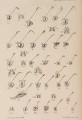
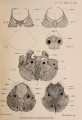
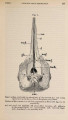
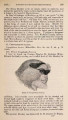
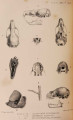
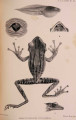
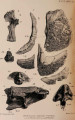
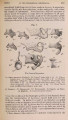
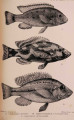
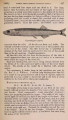
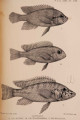
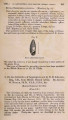
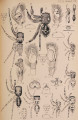
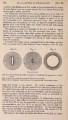
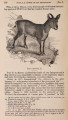
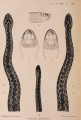
Show DR. A. GtJNTHER ON REPTILES, BATRACHIANS, AND [Nov. 7, H E M I C H R O M I S AFER, sp. n. (Plate LVII. fig. B.) D. -9. A. g. L. lat. 30. L. transv. JQ. Teeth conical, eighteen on each side of the outer series of the upper jaw. Scales below the eye in four rather irregular series; those on the neck and anterior part of the back much smaller than those of the body. In a specimen 4 inches long the diameter of the eye equals the width of the praeorbital and the depth of the scaly portion of the cheek, but is less than the width of the interorbital space, which is convex. The angle formed by the praeopercular limbs is a right one. Snout short and obtuse, shorter than the postorbital portion of the head, the lower jaw not projecting beyond the upper. The height of the body is somewhat more than the length of the head and equal to one third of the total (without caudal). Dorsal spines of moderate strength and length, the longest being about two fifths of the length of the eye. Pectoral fin reaching to the vent. Body uniform more or less dark brown, a spot on the end of the opercle and all the fins deep black. Gill-rakers short, some of them T- or hammer-shaped. Two specimens, the longer 4 inches long, were collected by the Rev. J. A. Williams. BAGRUS MERIDIONALIS, sp. n. This species is closely allied to B. bayad, agreeing with this Nilotic form in the shape and configuration of the head and the number of fin-rays, but the dorsal and pectoral spines are much weaker, scarcely stronger than the rays ; the maxillary barbels are shorter, only about as long as tbe head; and the adipose fin occupies a much shorter space of the back, its distance from the dorsal fin being equal to the length of the latter. The dry skin of a specimen 2 2 | inches long has been sent by Mr. Johnston from the Upper Shire River ; of course, it would occur also in the Lake itself, and it probably reaches to a very considerable size, like its congeners. ENGRAULICYPRIS, g. n. Cyprin. Shape of the head and body elongated, cylindrical like that of an Anchovy. Scales of moderate size, deciduous. Lateral line? Dorsal fin short, with less than nine branched rays, opposite to the commencement of the anal. Anal fin with about fourteen rays. Snout compressed, with the mouth of moderate width, lateral; the upper jaw almost entirely hidden below the large praeorbital. Suborbitals covering nearly the entire cheek. Gill-rakers very slender. Pharyngeal teeth in a double series, pointed. ENGRAULICYPRIS PINGUIS, sp. n. D. 11. A. 14. L. transv. 9 or 10. Body very low, subcylindrical, its depth being one seventh or one eighth of the total length without caudal; the length of the |