| OCR Text |
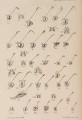
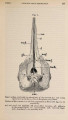
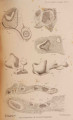
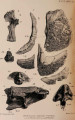
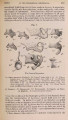
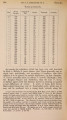
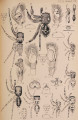
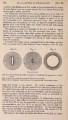
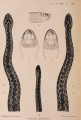
Show 1893.] ON THE GENITALIA OF BRITISH EARTHWORMS. 319 first synonym on the list after those already cited is C. canoroides, S. Miiller (Verhandelingen nat. Gesch. Nederland. overz. Bez., Land- en Volk. p. 235). It is far from clear that birds belonging to more than one species are not included, and as the wing is said to measure 8^ inches in some of the specimens, those skins, as Seebohm has pointed out, must belong to C. canorus. Under these circumstances the name, which is barbarous, may be safely ignored, the more so that it is not clearly antecedent to G. saturatus, a name of Hodgson's published by Blyth in 1843 (J. A. S. B. xii. p. 942) and quite unobjectionable. The description given by Blyth (J. A. S. B. xi. p. 903), who regarded this form at the time as an old C. micropterus, though brief, was sufficient for its recognition. I propose, therefore, to use the name C. saturatus for the Himalayan Cuckoo. 4. Further Observations on Variations in the Genitalia of British Earthworms. By M . F. W O O D W A R D , Demonstrator of Zoology, Royal College of Science, London. (Communicated by Prof. G. B. H O W E S . ) [Eeceived March 15, 1893.] (Plate XXIV.) In a former communication on this subject, published in the Society's ' Proceedings' for 1892 (p. 184), I described an abnormal Earthworm (Allolobophora, sp. inc.) possessed of six additional pairs of ovaries, situated one on the segment immediately in front of the normal pair and the remaining five pairs on the segments behind it. I have since examined very carefully a large number of Earthworms belonging to the genera Lumbricus and Allolobophora, and now find that the presence of additional pairs of genital glands, both ovaries and testes, is of by no means rare occurrence. In order to form some idea as to the proportion of these abnormal individuals, I took 50 worms at hazard from three localities near London and comprising five species \ and found 14 specimens, or 28 per cent., in which additional genital glands were present, or, practically, one worm in every four abnormal. The proportion is, however, very variable, as is proved by the fact that whilst most of the abnormal individuals came from one locality, in worms from other places abnormalities were much rarer. These variations all involved a repetition of the genital glands, but the individuals varied among themselves: thus in four specimens there were present additional glands on the mesenteries 1 Allolobophora longa, 23 specimens : 17 normal, 6 abnormal. A. turgida, 13 specimens: 9 normal, 4 abnormal. A. chloritica, 2 specimens : both normal. Lumbricus terrestris, 8 specimens: 6 normal, 2 abnormal. L. rubellus, 4 specimens; 2 normal, 2 abnormal. 22* |