| OCR Text |
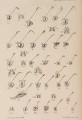
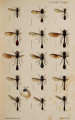
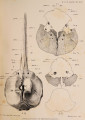
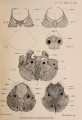
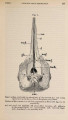
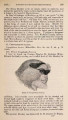
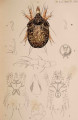
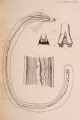
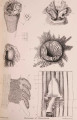
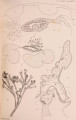
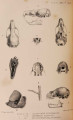
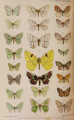
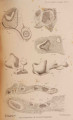
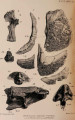
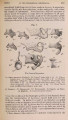
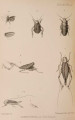
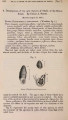
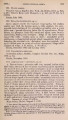
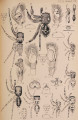
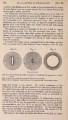
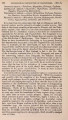
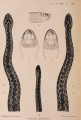
Show 336 MR. O. THOMAS ON MAMMALS FROM CENTRAL PERU. [Apr. 18' 10. ARTIBEUS1 GLAUCUS, sp. n. (Plate XXIX. figs. 7-9.) a. $ al. Chanchamayo. Type. Dentition as in the restricted subgenus Artibeus, of which the only known member is the large " A. perspicillatus" whether that is or is not subdivided into four or five local " species." Size as in the little A. (Bermanura) einereus. Anterior edge of nose-leaf free, its sides without extra lobes, its upright portion rather narrow and elongated. Ears rather short, their inner edge and tip broadly rounded, their outer edge with two slight concavities separated by a convexity. Wings to the end of the metatarsus. Interfemoral membrane emarginate to a point rather above the level of the middle of the tibia. Eur above extending on to the proximal half of the foramen and base of antebrachial membrane, and there is a patch on the metatarsus of the thumb. The wings are covered as far as a line extending from the elbow to the knee, the interfemoral is thinly clothed on its basal half, and the legs are covered with fur right down to the claws. Below there is a sparse covering on the membrane near the body and on the base of the forearm, but the interfemoral membrane is almost naked. Colour uniform cinereous grey, the lower surface scarcely lighter than the upper. Two faint whitish supraorbital streaks just distinguishable. Skull in its general outline almost as elongated as that of A. bilobatus, and sharing with that species in the less abrupt rise of the brain-case above the level of the muzzle; but while in A. bilobatus it is the muzzle that is raised, in A. glaucus it is the brain-case which is depressed, so that there is no really close resemblance between the two. General palatal outline broader and shorter than in A. bilobatus, but not so much so as in A. cinereus and quadrivittatus. Teeth. Upper inner incisors broad, vertical, spatulate, bicuspid, the inner cusps slightly longer than the outer. Outer incisors about half the height of the inner. Upper canines and premolars rather short and thick. N o trace of 5^, although m2 has a slight and inconspicuous concavity in its posterior edge. Lower incisors equal, bicuspid ; lower canine and posterior premolar attaining the same altitude ; n? of about the same horizontal length asm1; n? rounded, minute, its size in cross section only about equal to that of one of the lower incisors. Dimensions of the type, a slightly immature female2 in spirit:- Eorearm 43 m m . ; head and body 51 ; ear from notch 15-5; nose-leaf, length 11-7, breadth of horizontal part 6*1, of upright part 4; length of thumb 9-3; tibia 15-2; foot 10; calcar 4-1; depth of interfemoral in centre 7. 1 There appears to be no reason why this name should not be retained as originally formed by Leach, or why Agassiz's derivation of it from dpri and /3aw should be rejected ; Winge's proposed amendment of it to Artobius (' Bats of Lagoa Santa- E Mus. Lundii,' p. 38, 1892) is therefore unnecessary. 2 Teeth all up and in use, but epiphyses of limb-bones not fully united. |