| OCR Text |
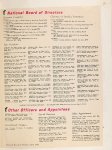
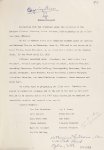
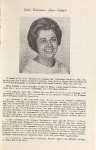
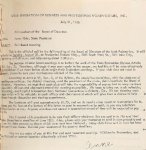
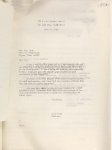
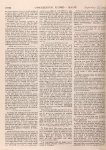
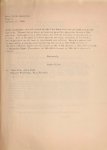
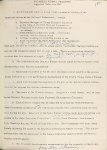
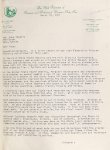
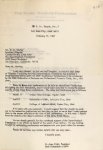
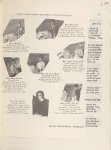
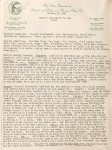
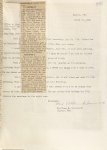
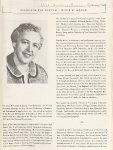
Show 14 in order to give her credit for all service, both on Q_ club and community level. In this ;' connection, summaries of cQndidatesl qualHications wi II- be included when pictures are posted at Convention. It ·is also hoped that each candidate may be brought Into the Nominating Committee Meeting on Iv\ay 5 to be introduced and that the committee members wil" in turn, identify all candidates to the delegates and members of their respective clubs and introduce them whenever conven ient • J consider it an honor to have chairmanned this Committee during the past year and sincerely appreciate the fine cooperation of our State President and her officers. The assistance and cooperation of the club presidents is also acknowledged, together with the following members who will act on the Committee: Mildred Corrigan, Bonneville; 110 Fesler, Bountiful; Alberta Va lentine, Brigham City; Frieda Withrow, Cedar City; l'V'kJe W. 'Moore, Coo Ivi lie; Iva Barrows, Ensign; Esther Olsen, Logan; Alice Shaw, Ogden; Wanda M. Hancey, Orem; Jane Brown, Panguitch; Clarissa Benjomin, Price; Amelia Buckley, Provo; Gretta S. Bour, Sa It Iroke City; laura W Pennypacker, Spanish Fork; l\kJry Louise Gi Imer, Sugar House; and Ouida Blanthorn, Tooele. Twelve clubs have not yet advised the names of their repre sentatives; however, we hope to have a complete list of committee members and alternates .:; · r • before Convention. Cynthia Curtis PARLIAMENTARIAN The Evolution of Modern Parliamentary Practice The roots of the word "parliament" made plain and enrich its meaning as a forum of free and open discussion, which is the essence of representative se If-gove'rnment. Men chosen by their peers to exercise the responsibilities of government must come to a meeting of minds, and parliamentary law spells out the rules not only to assure orderly progress toward that goa I but to protect at every step the right of the minority to present its case fully. The great body of parliamentary law has grown gradua IJy over the development of the ldecl of free representative government,. and every provision is based on long experience. The theory of parliamentary government reached its first interpretation in Britain, where the representative assembly in which true authority is centered became known as PARLIAMENT. Free parliamentary government was not achieved without a long and bitter struggle, however, and the word suggests the many critica I historic events which preceded its full realization. Internal wars of rival chieftains preceded the recognition of a unifying sovereign, and the struggle of the masses to throw off the slavery of feuda I ism forced the signing of the Iv\agnc Carta at Runnymede" Parliamentary law was an ideo and a force that could not be denied, and its first great interpretor and prophet arose in the person of Thomas Hobbes, 17th Century phi losopher whose teachings were perfected by John Locke in the ideo that iust government !s a contract for the people's mutual good and if the contract is broken', the people have a right to revoke and change the contrct. The contract theory was ad.eopted by Th?mas Jefferso in was Incorporated an the preamble to the Declaration of Independence, and its phdosophy the Constitution in the Bi II of Rights. |