| OCR Text |
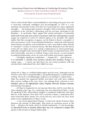
Show Rationality and the Structure of the Self, Volume I: The Humean Conception 235 On the other hand, merely to envision something as a consequence is not the same as desiring it, even if one envisions it as in some way satisfying to oneself. I can envision something as satisfying without being moved to achieve that satisfaction (right now, for example, I am envisioning the satisfaction of floating in the shallow water of the beach at Negril, but actually I am completely satisfied sitting here at my computer). But I cannot be said to desire that thing if I am not so moved. However, that the object of an other-directed desire is envisioned as a source of personal satisfaction does imply that if no such satisfaction were anticipated, one also could not be said to desire that thing. Even if one assigns no value to the satisfaction itself (and of course one can be satisfied by something, such as a chocolate-covered cherry, without valuing it), it is still conceptually impossible to desire that object unless one anticipates the satisfaction as a concomitant of it. So I can envision a satisfaction without desiring it, but I cannot desire a satisfaction without envisioning it as such. Envisioning an object or state of affairs as personally satisfying is a necessary but not a sufficient condition of desiring it. This is true by definition of "desire," and holds whether the desire is self-directed or other-directed, benevolent or malevolent. 1.3. Interest in vs. of a Self In this sense the satisfaction of all such desires do fall under the rubric of personal gain (similarly, one can gain something, such as rental property, without valuing it), and so more generally under the rubric of self-interested motivation (therefore, it can be in one's interest to gain something, such as a painful lesson about human nature, without valuing it). According to this classification, to realize an other-directed desire is, at the very least, a shortterm personal gain because of the personal satisfaction this will bring, even if it also requires personal sacrifice. So, for example, a person who desires to devote her life to the liberation of her country receives personal satisfaction from doing so, even if she loses her life in the effort. And because she anticipates receiving this personal gain, her devotion is self-interested. One can be self-interestedly motivated to satisfy an other-directed desire that demands the sacrifice of one's life because survival is not necessarily the only, or the most important, or the highest interest in the condition of one's self one can take. Interests in the condition of one's self that may outweigh one's interest in its survival may include interests in its integrity, rectitude, or surrender. Indeed, even one's interest in an anticipated personal gain may conflict with one's interest in survival, as when one endangers one's life for the sake of a high-risk but high-paying job. Similarly, the self may take an interest in satisfying its other-directed desires which is just as strong as, or stronger than, its interest in satisfying its self-directed desires. The sense in which the Humean model of motivation implies self-interest as the most © Adrian Piper Research Archive Foundation Berlin |