| OCR Text |
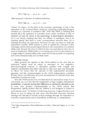
Show Chapter IV. The Utility-Maximizing Model of Rationality: Formal Interpretations 136 arithmetically by a constant difference while the external stimulus increases geometrically by a constant multiple, the final form of Fechner's law is (2) S = K log R, where S is the magnitude of the sensation, K is a constant, and R is the 9 magnitude of the stimulus. But whether JNDs can be assumed to be equal, even within a given sensory modality, is - as before - open to question. On what grounds can a subject (let alone the observer) conclude that the perceived difference between weightlessness and noticeable physical weight is equal to the difference between noticeable weight and just noticeably heavier weight? Or between the latter and weight just noticeably heavier than that? In order to justify this assumption, there would have to be some way of measuring, not only the material increases in physical weight of the respective stimuli relative to the sensation of increase reported by the subject; but also the sensed intervals between each of these increases. It is hard to imagine how these sensed intervals themselves could be measured; or why, in the absence of such measurement, they should be assumed to be equal. However, there are more serious problems with Allais' reliance on this theory. The Fechner-Weber laws have been long since overtaken by more recent developments in experimental psychology. For example, it transpires that their ratios differ according to the sensory modality. Also, they hold only for the middle range of stimuli and not for extremes at either end of the spectrum. Further, what counts as an extreme differs from one subject to 10 another, as do absolute stimuli thresholds. But putting aside even these doubts, what relevance can the Fechner-Weber laws have for measuring the cardinal utility of various complex outcomes of action? Are we supposed to count the number of sensory modalities involved in each projected outcome and sum their respective ratios? Or multiply them? What if their sensory modalities have nothing to do with their psychological value for a particular agent? What if a psychologically valuable outcome engages none of the agent's sensory modalities, but rather her intellectual or aesthetic discrimination? What if the gambles an agent confronts involve, not simply various sums of money, as Allais supposes, but more complex but pedestrian intangibles such as status, intellectual stimulation, or self-worth, none of which can be realistically calibrated in terms of monetary gain? 9 G. T. Fechner, Elements of Psychophysics, Vol. I, Trans. H. E. Adler, Ed. E. G. Boring and D. Howes (New York: Holt, Rinehart and Winston, 1966). 10 These more recent developments are summarized in Robert Watson, The Great Psychologists: From Aristotle to Freud, Second Edition (New York: J. B. Lippincott Co., 1968), 232-239. © Adrian Piper Research Archive Foundation Berlin |