| OCR Text |
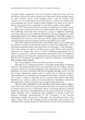
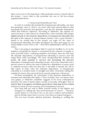
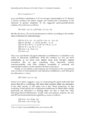
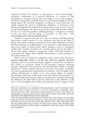
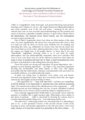
Show Chapter III. The Concept of a Genuine Preference 126 (I) Fy. y=z. Fz (II) y=y offered a model for schematized axioms of nonself-contradiction, thus: (I') Fy. ~(y.~z). Fz (II') ~(y.~y). We also saw that one result of substitution of (I') was (2) x=y. ~(y.~z). x=z from which would follow (3) ~(x.~y).~(y.~z). ~(x.~z), which I described as the law of transitivity of nonself-contradiction. I suggested that the requirement of nonself-contradiction among terms and variables might function in proofs, as does the identity sign, either as an inert predicate letter or truth functionally with the insertion of an axiom of nonselfcontradiction into the antecedent of the conditional. In turn, (3) implies (4) (xy).(y z).(x z) and therefore (5) (~x v y).(~y v z).(~x v z). The value for present purposes of (II') and (3) - (5) is that first, they establish the criterion of horizontal consistency among independent variables, and hence among subsentential constituents. Second, therefore, they demonstrate a way in which the Boolean connectives might function among variables, not only among the quantified sentential propositions that contain them. Basically, these connectives function in a monadic predication of x in (II'), and in a dyadic predication of x in (3) - (5). These are some of the tautologies that can be imported from the sentential calculus to the variable term calculus I am suggesting. But the goods to be imported need not be restricted to tautologies. Given certain restrictions to be explicated shortly, the entire truth-functional apparatus of familiar logical connectives, rules of inference, and tests for consistency as well as validity is potentially available. This is fortunate, since whatever (T) is, it is not a tautology. So I shall use the available resources of © Adrian Piper Research Archive Foundation Berlin |