| OCR Text |
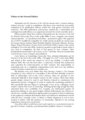
Show Chapter II. Reason in the Structure of the Self 98 as instances of life, death, etc. as in turn having the self-consciousness property, I could not conceive of any of these things as objects of my experience. Of course this does not mean that they would not be objects of my experience; just that I could not conceive them as such. But an agent who lacked the concept of the self-consciousness property even implicitly would lack the capacity to recognize herself as partially responsible for the character of those experiences - and so, finally, would lack 27 a necessary condition for motivationally effective agency. Consider what such an agent might be like. She might have concepts of properties that attach to the de facto objects of her experiences, i.e. to the events, objects, and states of affairs she experiences, for example, being human nature, or bright red, without thereby having the concept of herself as subject of them. In this case, she would regard a characteristically human or bright red object of experience impersonally as occurring, but not as occurring to anyone. Alternately, she might have, in addition, concepts of properties that attach to herself as a subject of experience, i.e. to the way she experiences such events, objects, and states of affairs, for example, being surprised by something, or open-minded to something, or desiring something. She would have to regard such intentional states of surprise, or open-mindedness, or desirousness as happening to her. But she would not necessarily regard them as her states. Instead, she might feel involuntarily overtaken by surprise, or stripped of her opinionated defenses, or propelled by desire, in spite of her character dispositions and impulses. In this case, she would view these states as alien and invasive psychological forces that happen to her, but not, as it were, from her. Most of us experience this sense of powerlessness over and detachment from our own intentional states at some point. Many feel this way about sexual attraction, or compulsive gambling. Others may claim to feel this way about all experience; that is, they may take the naive realist view that the character of a particular experience they have is entirely dependent on the character of its objects, and not at all on that of its subject. In order for an agent to regard his experiences of different things as objects of his experiences, he must be able to recognize such experiences not only as occurring in just that form exclusively to him, but a fortiori as doing so in virtue of his nature. That is, he must be capable of viewing such experiences as not only affecting him, but also as being partly determined by him. Thus he needs to be able to recognize his experiences as the result of an active, reciprocal collaboration between their subject and their objects, and as having the particular character they do in virtue of that collaboration. 27 The ideas in the following paragraphs benefited greatly from careful study of Joel Feinberg's "The Idea of a Free Man," in Rights, Justice, and the Bounds of Liberty (Princeton, N.J.: Princeton University Press, 1980). © Adrian Piper Research Archive Foundation Berlin |