| OCR Text |
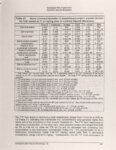
Show - Ecological Risk Assessment North Oquirrh Mountains Appendix 2 900 ppm) for 98 days (n=8 per group) showed no ill effects (Felsman et al., 1973). However, calves fed Cu as Cu-sulfate at 115 ppm (Shand and Lewis, 1957) or 300 ppm (Weiss and Baur, 1968 as cited in NRC, 1980; original article not available) developed signs of toxicosis and death. However, the ratio of Cu to Mo in the diet is also extremely important in determining the toxicity threshold of Cu. If this Cu:Mo ratio is between 2:1 and 6:1, the total Cu content of the diet for sheep (the most sensitive species) can increase as high as 30 ppm with no ill effects (Buck et al., 1976) and to well above 100 ppm in cattle. Therefore, a NOAEL for ruminants is 7.3 to 30 ppm and a LOAEL is 26.6 to 38 ppm depending upon the Cu:Mo ratio. Swine are also more resistant to Cu poisoninq than are sheep and 250 ppm Cu as Cu sulfate has been used routinely as a feed additive for swine, due to its antimicrobial and growth promotion effects (NRC, 1980). OeGoey et al. (1971) and Combs et al. (1966) fed pi.gs diets supplemented with Cu-sulfate at 250 or 500 ppm and observed an increased rate of growth at 250 ppm with reduced growth, anemia, and death on the 500 ppm ration. Suttle and Mills (1966) observed reduced growth rates and skin ulcers in pigs fed 425 ppm Cu, as Cu-suIfate, for three weeks. A diet of 1,000 ppm Cu, as Cu-sulfate, was fatal for 19 pigs over a 10 week period (Allcroft et al., 1961). Ponies fed 19,618, 1,082, or 1,866 ppm Cu-sulfate for six months showed no clinical signs at any of the concentrations, although liver Cu concentrations were significantly elevated at the highest level (Smith et al., 1975). Young rats fed Cu sulfate in diets at 500, 1,000, 2,000, or 4,000 (n=3' to 8 per group) for up to 70 days showed no effects at 500 or 1,000 ppm, marked weight loss at 2,000 ppm, and severe anorexia and death by day seven at 4,000 ppm (Boyden et al.,1938). A NOAEL for monogastric mammals, based on these data, is 250 ppm and the LOAEL is 425 ppm. Mehring et al. (1960) fed cuprous oxide to chickens at 500 or 1,176 ppm for 10 weeks and growth retardation (to 50% of control weights) in the 1,176 ppm treatment group. Copper acetate at 800 ppm diet for five weeks caused we'ight loss in chickens and 1 ,600 ppm resulted in mortality (Goldberg et al., 19'56). Young turkeys showed no ill effects in 21 days from Cu-sulfate amended diets at 400 ppm but had Significant growth reductions at .800 and 910 ppm with death at 3,240 ppm (Vohra and Kratzer, 1968). Waibel et a/. (1964) fed turkeys diets containing SO, 100, or 800 ppm Cu as Cu-carbonate or Cu-sulfate and observed mortality at 50 ppm when the Cu was added to a highly purified diet, but recorded no effects at all when a normal basal diet was used. This experiment illustrates the interaction of Cu with other dietary constituents (e.g., Mo, Zn, S, protein) There·fore, a NOAEL for herbivorous birds (based on chicken and turkey data) is set at 500 ppm and a LOAEL is 800 ppm. observed 2.6.1.2 Wild Birds Seventy-two ducklings (Anas sp.) fed Cu-sulfate at 100 ppm for eight weeks showed no ill effects Wobesser (1981) reported a finding of several Canada Geese (Branta (King, 1975). canadensis) that died shortly after feeding on a pond treated with Cu-sulfate. The geese had ingesta containing 324 to 613 ppm Cu. Wobesser (1981) also cites a Single study where mallards (Anas platyrhynchos) fed 250 ppm Cu-sulfate showed no obvious signs of poisoning. Finally, Wobesser (1981) states that the evidence for Cu poisoning in wild waterfowl is not convincing. Therefore, the NOAEL and LOAEL values for herbivorous birds remains at 500 ppm and 800 ppm, as detennined by studies with domestic fowl. 2.6.1.3 Wild Mammals (1982) conducted a study on the effects of Cu (as CUS04) on mink amending a control diet (containing 60.5 ppm Cu.dry wt) with 25, 50, by reproduction and 200 100, ppm Cu. No effects were observed on adults or reproductive parameters 110 to ppm (i.e., 60.5 plus 50 ppm). At dietary concentrations of 160 ppm Cu and up Aulerich et al. 12 ecological planning and toxicology, inc. |