| OCR Text |
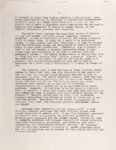
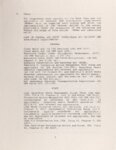
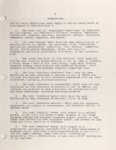
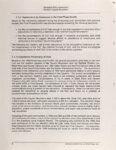
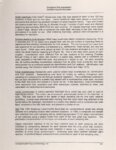
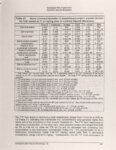
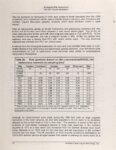
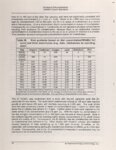
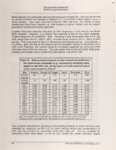
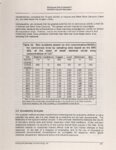
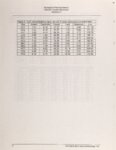
Show -" Ecological Risk Assessment Northern Oquirrh Mountains these canyons, thus potentially reducing their exposure to dietary Se. This may not be true for smaller predators like racooons or weasels, but it is unknown if these species occur in these canyons. None were observed during the 1995 field work, and habitat in lower Kessler and Black Rock Canyons (Le., little wooded or riparian habitat) may not support populations of small mammalian camivores. Coyotes have been observed frequently by KUC employees in both Kessler and Black Rock Canyons. However, it is unlikely they consume a diet of only small mammals. Coyotes weigh 9 to 22 kg (USEPA 1993). Assuming a food consumption rate of 0.07 gig body weight (from red fox, USEPA 1993), a coyote would consume 630 to 1,540 g of food per day. This is equivalent to 30 to 73 Peromyscus-size animals per day. Consequently, it is unlikely, given the size of the canyons and the population density of Peromyscus and other small mammals, that coyotes would be completely supported by consuming small mammals only in these two canyons. They also would have to consume other larger prey, probably over a larger area to sustain their daily dietary consumption rate. Table 31. Risk quotients (based on diet concentration/NOAEL) for carnivorous mammals (e.g., coyotes) by sampling sites based on the 95% UCL of the mean of small mammal whole body concentrations of CoC1• Site Arsenic NOAIiL NA 47 (mg/ko) I Lead Selenium Zinc 110 6 4.8 500 0160 38 7.2 1,500 Cadmium Copper I, II LOAEL 10 50 (mg/kg) CC1 0.08 1.32 1.35 0.19 0.04 0.02 0.01 0.14 CC2 0.15 0.30 0.55 0.20 LV1 0.06 0.02 0.17 1.21 0.86 0.19 LV2 0.06 0.01 0.15 0.37 0.66 0.17 KC1 0.13 0.01 0.71 1.90 3.82 0.19 KC2 0.17 0.01 1.19 2.42 3.29 0.20 BR1 0.10 0.01 0.37 2.44- 3.07 0.20 8R2 0.13 0.01 0.61 1.99 3.06 0.20 PC1 0.08 0.06 0.12 3.30 0.58 0.19 4.66 0.66 0.17 2.28 0.56 0.18 PC2 0.10 0.06 0.17 PC3 0.04 0.05 0.11 , Diets of carnivorous mammals were calculated as 100% anima'l tissue using the 95% UCL of the mean of the whole body concentrations (ppm, dry wt) of CoC in all small mammals from each samQl,ina site. Risk quotients 1 are presented in bold italics. Risk quotients calculated for carnivorous birds feeding primarily on small mammals were estimated by comparing the 95% UCL for small mammal whole body concentrations of CoC with the NOAELs for carnivorous birds from Table 26. The risk quotients for carnivorous birds were below 1.0 for all CoC except Se, where estimated dietary 80 ecological planning and toxicology, inc. 1 |