| OCR Text |
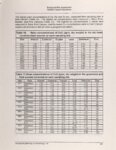
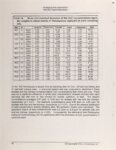
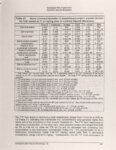
Show Ecological Risk Assessment Northern Oquirrh Mountains The whole body concentrations of shrews were approximately two to six times those in white-footed mice in Pennsylvania. Two of three shrews necropsied by Beyer et a/. (1985) healthy with no lesions that could be attributed to metals, although aminolevulinic acid dehydratase (ALAD) activity was reduced, a sign of exposure to Pb. One shrew collected by Beyer et a/. (1985) showed evidence of Pb poisoninq (i.e., acid fast intranuclear inclusion bodies in one kidney and reduced ALAD activity). There were no acid-fast intranuclear inclusion bodies found in the 1995 EcoRA samples from sample sites in the northern Oquirrh Mountains where Pb concentrations were approximately 3 to 100 times lower than in the smelter site investigated by Beyer et a/ (1985). seemed to be .. For birds and mammals that forage primarily in plant foliage (e.g., and in the air (e.g., swallows and bats), risk quotients were estimated by insectivorous chickadees) comparing the mean CoC concentration in surface-dwelling and foliar invertebrates (without adding 2% of soil concentration) with the lower of the measured or estimated NOAELs for insectivorous birds or mammals from Table 26 (Table 30). The mean of surface-dwelling and foliar invertebrates was used as a conservative estimate of aerial insect concentrations because samples of aerial insects were collected in only 3 of 11 sampling sites, but the concentrations in the aerial insects collected was almost always less than the mean of surface-dwelling and foliar invertebrates (see Section 2.3.1.3). In Appendix 12, the dietary CoC concentration for aerial feeders was estimated using the canyon, when available, and estimated as the mean of surface-dwelling and foliar invertebrates in canyons where no concentration from aerial insects collected within the aerial invertebrates were collected. dietary concentrations of Cd exceeded the NOAEL of 10 ppm in PC2 based on a study with mallards, as well as the LOAEL of 12 ppm based on a study with chickens, but was below the level of concern at the nearby PC3 (Table 30). Dietary concentrations of Se exceeded the 4 ppm NOAEL in Kessler and Black Rock Canyons, but exceeded the 5 ppm LOAEL only in KC1 and KC2. The dietary concentrations of Zn exceeded the 125 ppm NOAEL at all sampling sites, except BR1 (Table 30), but the LOAEL was exceeded only at The PC2. For insectivore food chains, the Screening Level EcoRA used assumptions (based on literature derived values) about trophic transfer factors (TTFs) that resulted in risk quotients that exceeded the NOAEL in all canyons for Cu and Pb. However, site-specific data on Cu and Pb concentrations in invertebrates were considerably lower than the Screening Level estimates and the TTFs were lower than 1.0 in all sampling Conversely, Zn concentrations in invertebrates were units, except for Cu in CC2. higher than estimated in the Screening Level EcoRA in all canyons, except Pine Canyon, where the concentrations much less than estimated. Se concentrations in invertebrates were higher than estimated in the Screening Level EcoRA in Kessler, Black Rock, and Pine Canyons. This was primarily because measured invertebrate concentrations of Se and Zn were unrelated were to soil concentrations. The large number of risk quotients exceeding 1.0 for Zn by insectivores reflects that the Zn concentrations in invertebrates of 107 to 290 ppm (dry wt) throughout the sampling sites compared to a NOAEL of 125 ppm. The LOAEL of 250 ppm was exceeded only in PC2. The Zn concentrations in soil ranged from 534 to 677 ppm (dry wt) in Pine Canyon, and ecological planning and toxicology, inc. 75 |