| OCR Text |
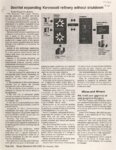
Show tq.,so, Bechtel expanding Kennecott refinery without shutdown Bechtel Engineering Bulletin "The Kennecott runs like clockwork Utah Copper Refinery a clock with 750,000' - moving parts. And Bechtel's challenge," says Kennecott project manager Ken Sutliff, "is to design and help Kennecott manage the construction of a modern, expanded version of this refinery without stopping that 'clock,' that is, without disrupting the synchroniza tion of refinery operations." The focus ofthe refinery's operations is the tankhouse, which produces a cathode copper with a purity of 99.9 percent, and the materials handling building, which receives anodes with a copper purity of 98.5 percent from the smelter, prepares them for further refining in the tankhouse, and processes the final product. Bechtel is also performing engineering, procurement and construction management for a new precious-metals facility that will extract gold, silver and selenium from the tankhouse slimes. Selection of the process technology and the $164 million modernization program required creative collaboration between Bechtel and Kennecott equipment implement to during conceptual design. Their decisions have resulted in a number of innovations among them: 1) The first commercial application of the - Falconbridge Kidd Process Technology for depositing refined cathode copper onto . prising the copper anodes that are consumed will substantially increase refinery profits by when electric current is applied to the elec trolytic fluid and the stainless steel blanks to recovered from slimes in the tankhouse. which the cathode copper migrates. This means that over 65,504 anodes and reduce the time needed to recover gold and 67,000 stainless steel blanks are in the pro silver from about 4 weeks to about 5 days. concrete cells the 11-square-foot anode weighs about 700 pounds. Prior to its removal from the cell, it concrete-lined cells in the tankhouse; weighs about 110 pounds, having serviced 3 2) The introductionof thin-walled polymer to replace the corroded the electrolyte; use of automated guided struction vehicles to transport batch loads of materials between the materials handling facility and areas. the refinery; and 5) The use of a hydrometallurgical rather than a pyrometallurgical process to recover made of flexible "shovel" cable. Modernization of the materials precious metals. Integration of these handling building was a I-step operation, performed by gutting an existing building and installing all the equipment at the same time. Bechtel completely redesigned the facility, integrating the functions of the new anode scrap wash and the anode preparation machine with the Falconbridge Kidd pro prietary stainless steel blanks and cathode stripping equipment. The automated guided vehicles are the lin chpin between the materials handling building and tankhouse operations. Bechtel requisitioned 7 a-foot-wide, 18-foot-Iong, wire guided vehicles separately at a savings in unconventional . technologies with other, more conventional refinery equipment will increase copper out put from 220,000 to 310,000 tons per year and lower unit costs by 35 percent. However, "the real accomplishment," says project manager Bill Bystrom, "is that we're performing sequential construction in operating plant without curtailing ongoing production.' Modernizing the tankhouse, which represents 50' percent of the project cost, could have been a logistics nightmare if Bechtel had not designated 8 areas for se quential installation of 1,424 new polymer concrete electrolytic cells. Four feet wide, 5 feet deep and 16 feet long, each cell holds 46 pairs of electrodes, coman , Page 24A . total installed cost of $500,000 over conven tional fixed-rail straddle cars. Battery powered and self operating, these vehicles require little maintenance. Construction of the precious-metals facility Rocky Mountain PAY DIRT for January 1995 . the modernization and expansion goal of converting a 40-year-old refinery into plant. a showcase Mines and Miners MK Gold gets approval of Therefore, Bechtel tem porarily reinstalled the old system in the new installations through the use of jumpers gold, selenium and silver program is completed in December 1994, Kennecott Utah Copper will have realized its successive stainless steel blanks. Tankhouse plans called for simultaneous conversion to the Falconbridge Kidd technology after completion of 6 of the 8 con 3) The installation of new rectifiers in the tankhouse to increase the current density in first When . sheets; out The hydrometallurgical process will also duction cycle at anyone time At the start of the electrorefining process, stainless steel rather than copper starter 4) The separating gold project in Kyrghyz MK Gold Company said December. 29th it had completed negotiations with its Kyrghyz r> partner, Concern Kyrghyzaltyn (KA), and received final approval of its feasibility study of the Jerooy gold project from the Kyrghyz government. Jerooy Gold Company, MK Gold's Kyrghyz affiliate, is now preparing for final design and construction. "The Jerooy feasibility study indicates the underground mine and carbon-in-pulp mill will produce approximately 175,000 ounces of . gold per year in the initial stage with an average annual production rate of 150,000 opy for 9 years," said Daniel Kunz, president and CEO of MK Gold. "While the partners have a goal to be in production in 1996, full produc-' tion is expected to be attained in 1997." MK Gold, headquartered in Boise, owns 30 percent of the shares of Jerooy Gold, a Kyrghyz joint stock company, and is serving as manager. |